

Be the Writer You Are
Twain, Lovecraft, and the case against universal rules of style
Dear Living Dark Reader,
There are many different ways of being a writer. The comprehensive field of possibilities encompasses a vast array of forms and styles. And you, as the unique individual that you are (or that you appear to be), are free to be the writer you’re meant to be instead of chaining yourself to someone else’s rule.
Having led with the point, let me unpack and illustrate it. Our focus here is the specific matter of style, and of how there is no uniform or absolute standard to which you are obligated to conform.
Mark Twain once gave some advice to a young student, a 12-year-old boy from Texas named David Watt Bowser, on the value of plainness in writing. This came in a letter whose origin is quite charming: In 1880 Bowser was the star pupil of one Laura M. Dake, who, twenty years earlier under her maiden name of Wright, had shared a three-day platonic romance with Sam Clemens during his youthful days as a steamboat pilot on the Mississippi River. Both parties had always remembered the relationship with fondness. Two decades later, Dake, now principal of Dallas’s Commerce Street School, encouraged her precocious student Bowser to send one of his English compositions to Clemens, who was now famous as Mark Twain. Twain was delighted to receive the letter, which included an account of its origin, and this led to a two-year correspondence between the man and the boy. Their letters remained private until 1959, a quarter century after Bowser’s death, when they were discovered in an old lockbox. The find was announced in The New York Times, and the letters were published the next year in The Southwest Review.
It is the postscript to Twain’s original letter to Bowser, dated March 20, 1880, that I want to focus on here. In the letter’s main body, Twain reflects on Bowser’s inquiry about whether he would like to be a boy again. He also lets the boy know that he has not yet read his composition. Then comes the postscript, which he added a little later:
Now I have read your composition, and think it is a very creditable performance. I notice that you use plain, simple language, short words, and brief sentences. That is the way to write English—it is the modern way, and the best way. Stick to it; don’t let fluff and flowers and verbosity creep in. When you catch an adjective, kill it. No, I don’t mean that, utterly, but kill most of them—then the rest will be valuable. They weaken when they are close together, they give strength when they are wide apart. An adjective habit, or a wordy, diffuse, or flowery habit, once fastened upon a person, is as hard to get rid of as any other vice.
It was a very large-hearted letter for Twain to have written to such a young correspondent. It is also an important letter for those of us identified as writers, particularly because Twain’s advice in that postscript has gone on to assume the status, for many, of the type of universal rule that I am here calling out for rejection. It has been widely quoted and much celebrated as one of the classic statements, by an acknowledged literary master, on the fundamentals of effective prose style. But for all this, and as much as I love Twain, I simply have to respond to it, or at least to its universal application, with an emphatic no. When Twain advised killing most adjectives, he was speaking for himself, which was fine, and he was also speaking in and for the specific rhetorical moment of his correspondence with young Bowser, which was right and proper. But this in no way makes his words qualify as a general rule. There is a clear and definite place for prose that presents a rich stew of descriptive language. There’s even a place for all-out baroque writing that teems and bristles with a profusion of adjectives, adverbs, and long, densely looping chains of phraseology.
An obvious authorial example that comes to mind is that of H. P. Lovecraft. Critics have sometimes condemned Lovecraft’s prose style for the supposed sin of what some have called “adjectivitis.” The major precedent for this was set early on by Edmund Wilson, who, as the most prominent American literary critic in the first half of the twentieth century, both reflected and helped to set what counted as mainstream opinion. In a 1945 New Yorker article titled “Tales of the Marvellous and the Ridiculous,” Wilson famously lambasted Lovecraft by opining that the only horror to be found in his stories was “the horror of bad taste and bad art.” Wilson criticized both Lovecraft’s general sensibility and his specific writing style, saying of the latter:
Lovecraft’s worst fault is his incessant effort to work up the expectation of the reader by sprinkling his stories with such words as “horrible,” “terrible,” “frightful,” “awesome,” “fearsome,” “eldritch,” “eerie,” “weird,” “forbidden,” “unhallowed,” “unholy,” “blasphemous,” “hellish,” and “infernal.” Surely one of the primary rules for writing an effective tale of horror is never to use any of these words.
Despite Wilson’s celebrated status in the literary world, it has to be said that in this case he was simply wrong. The style that he found so repellent and risible in Lovecraft was actually Lovecraft’s right and natural métier, one of the primary literary characteristics of the type of work that he, as the person and writer he was uniquely born to be, was meant to bring into the world. As S. T. Joshi has persuasively pointed out, it was a highly effective style for conveying the psychology, outlook, and worldview of Lovecraft’s many first-person narrators in the specific imaginary universe that he created and shaped with his stories and poems. In other words, Lovecraft’s prose style, baroque and ornate through and through, was perfectly suited to his authorial self and worldview.
There is a clear and definite place for prose that presents a rich stew of descriptive language. There’s even a place for all-out baroque writing that teems and bristles with a profusion of adjectives, adverbs, and long, densely looping chains of phraseology.
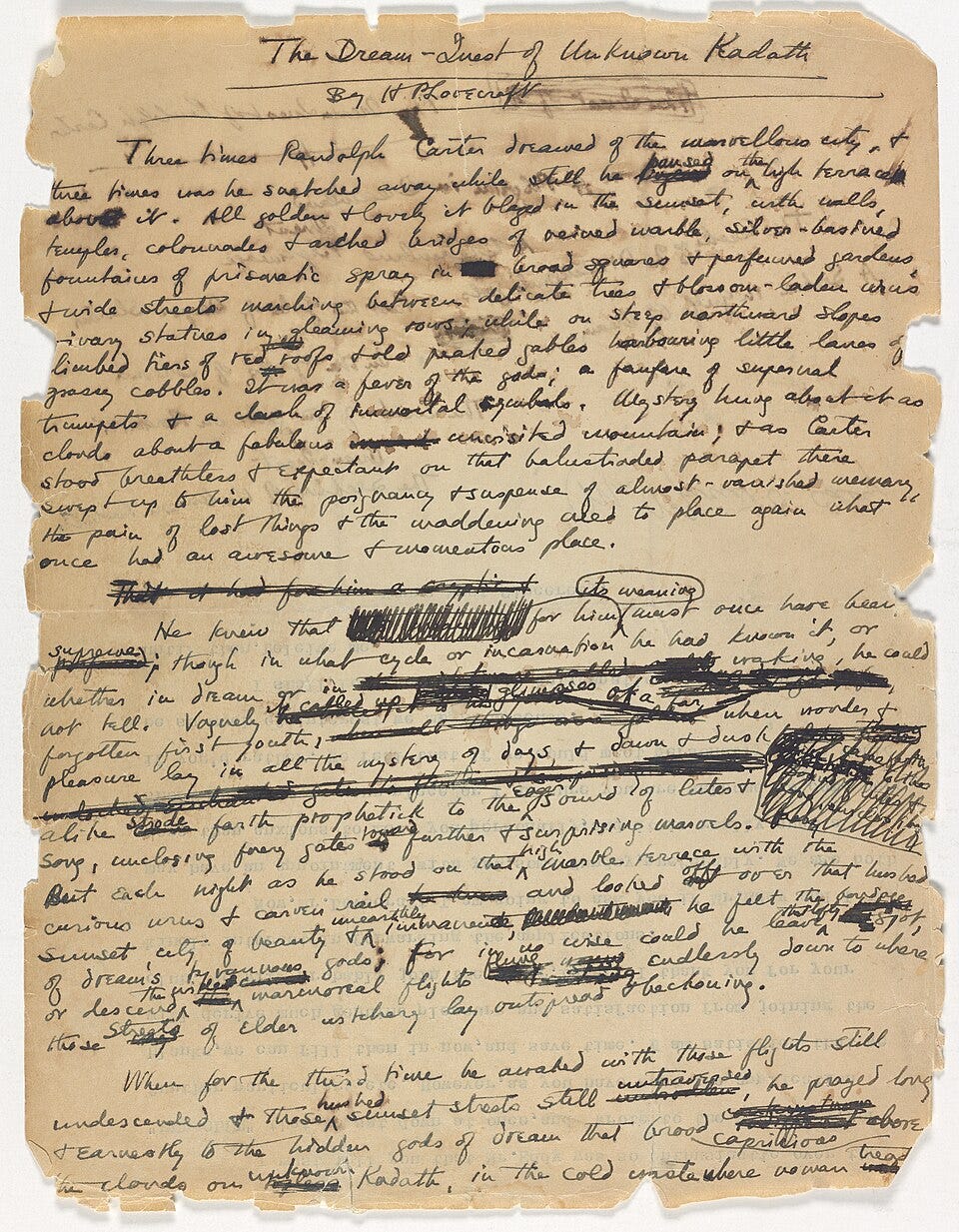
For just one example of this style in action, I direct your attention to the opening paragraph of Lovecraft’s short novel The Dream-Quest of Unknown Kadath, a work that is remarkable for many things, including the fact that the manuscript for it is a first draft that he never went back and revised:
Three times Randolph Carter dreamed of the marvellous city, and three times was he snatched away while still he paused on the high terrace above it. All golden and lovely it blazed in the sunset, with walls, temples, colonnades, and arched bridges of veined marble, silver-basined fountains of prismatic spray in broad squares and perfumed gardens, and wide streets marching between delicate trees and blossom-laden urns and ivory statues in gleaming rows; while on steep northward slopes climbed tiers of red roofs and old peaked gables harbouring little lanes of grassy cobbles. It was a fever of the gods; a fanfare of supernal trumpets and a clash of immortal cymbals. Mystery hung about it as clouds about a fabulous unvisited mountain; and as Carter stood breathless and expectant on that balustraded parapet there swept up to him the poignancy and suspense of almost-vanished memory, the pain of lost things, and the maddening need to place again what once had an awesome and momentous place.
Personally, I wouldn’t change a thing. Everything about it is perfect, both as a stand-alone passage and as the opening paragraph of the tale that follows, which takes place in the world of dreams. Lovecraft begins the novel with a paragraph that contains nearly fifty adjectives and adverbs. Stating that number alone might make it seem excessive, like an assault by modifiers, a clear example of Wilson’s “bad art.” But in the actual reading of it, the effect is not excess but incantation. It reads like a dream, like a visionary spell being cast to draw the reader in—which in fact it is, and which is entirely appropriate to the story being told.
In Ray Bradbury’s classic 1948 story “Pillar of Fire,” a man named Lantry who died in the twentieth century wakes up four hundred years later in a thoroughly sanitized and imaginatively flattened future world where death is hidden and anything that suggests darkness or fear is policed and suppressed. Discovering this, at one point he goes to a library to check on the fate of supernatural literature in such a society. He asks the librarian if they house any books by Poe, or Machen, or Bierce, or Derleth. He also asks about Lovecraft. The reply for each is the same: These were all part of the great burning a century earlier, and good riddance, too. Later, as Lantry reflects and fumes over this galling travesty, one of his infuriated thoughts is, “You destroyers of Edgar Allan Poe and fine big-worded Lovecraft, you burner of Hallowe'en masks and destroyer of pumpkin jack-o-lanterns!” I first read this story in junior high school, several years before I read Lovecraft, and I think Bradbury’s descriptive phrase, issuing from the mouth of the story’s protagonist, may have been the first time I ever heard of him: “fine big-worded Lovecraft.” For me, that set the tone through which my later expectations were both shaped and fulfilled. Lovecraft with his big words and ornate style is indeed fine. Very fine, indeed, with no remedial application of Procrustean principles needed for his prose.
Having laid out the illustrations at some length, I hasten to loop back to the point: What was true of Lovecraft is true of many other writers as well—including you and me. The work of many fine writers contains a full complement of adjectives and even, gasp, adverbs, despite prominent figures from Elmore Leonard to Stephen King to Kingsley Amis being lined up against them. “The adverb,” says King in On Writing, “is not your friend. . . . I believe the road to hell is paved with adverbs, and I will shout it from the rooftops.” And yet we have a host of counter-examples that we can draw on without too much effort, from Dickens to Faulkner to J. K. Rowling, who have loved a good adverb and not hesitated to use it. We also have examples immediately available of writers both historical and modern who have loved, and in loving have elevated the use of, prose that is distinctly ornate and/or baroque, from Oscar Wilde and Vladimir Nabokov to Gabriel García Márquez and Angela Carter.
Do what you are uniquely supposed to do, and do it in the way that you are uniquely equipped, qualified, and inclined to do it. Be the writer you are called to be.
I will cede the floor momentarily to David Bentley Hart, who, in his 2022 essay “How to Write English Prose,” gave us one of the most pungent attacks on the culturally dominant advice regime of lean prose that you’re likely to come across:
I do not know exactly why, in the twentieth century, the dominant fashions in English prose moved relentlessly in the direction of ever greater simplification and aesthetic minimalism. I do not even entirely regret it. Tastes change, and some of the change has been a corrective of certain excesses of the past. But, on the whole, the result has been a kind of official dogma in favor of a prose so denuded of nuance, elegance, intricacy, and originality as to be often little better than infantile, not only in vocabulary but also in artistry and expressive power—a formula, that is, for producing writers whose voices are utterly anonymous in their monotonous ordinariness. . . .
All these vapidly doctrinaire injunctions—urging you to write only plain declarative sentences stripped of modifiers and composed solely of words familiar to the average ten-year-old and demanding that you always prefer charcoal-gray to sumptuous purple—are expressions of everything spiritually deadening about late modernity and its banausic values. They reflect an epoch in which the mysterious, the evocative, and the beautifully elliptical have been systematically suppressed and nearly extinguished in the name of the efficient, the practical, the mechanical, and the starkly unambiguous—in short, in the name of everything that makes existence uninviting and life boring. They are reflections of an age of bloodless capitalist economism, the reign of brutally common sense, the barbarian triumph of function over form, a spare, Spartan civic architecture of featureless glass and steel and plastic, a consumerist society that lives on the ceaseless production and disposal of intrinsically graceless conveniences. Learn to detest all of these things and you will be a better writer for having done so.
The upshot of all this, from Twain to Lovecraft to Hart and all the other examples and ideas that I have invoked, is easy to identify: Good writing is not all one way. Sometimes, for some writers and occasions, good writing emerges as spare, sleek, and lean. At other times, for other writers and occasions, it emerges as dense, wordy, complex, and ornate. And the latter, no less than the former, when deployed rightly—meaning organically and skillfully, as the natural flowering and expression of the writer’s spirit of creative genius—is glorious just as it is, with no need for any change, which could only diminish it. “I notice that you use plain, simple language, short words, and brief sentences,” said Twain to Bowser. “That is the way to write English—it is the modern way, and the best way. Stick to it; don’t let fluff and flowers and verbosity creep in.” That was great and valid advice for Twain himself, and perhaps for Bowser. It was not great advice for Lovecraft, or for Wilde, or for anyone whose natural mode of expression goes in the opposite direction. The question now before us is: What kind of writer are you? What kind am I? Answer carefully and honestly, and only for yourself.
When it comes to writing, there is no such thing as a rule that is universal, absolute, and applicable to everybody. Or rather, the only universally valid advice is really a piece of anti-advice. I often like to paraphrase Bradbury on this point, as processed through my lifetime of reading his stories and essays, including his wonderful, necessary, life-giving advice on writing. One of the cornerstones of this advice might be rendered as follows:
Never listen to a damned thing anybody tells you. Find your own way. Do what you are uniquely supposed to do, and do it in the way that you are uniquely equipped, qualified, and inclined to do it. Be the writer you are called to be. And to hell with everyone else.
Warm regards,

The Living Dark is freely published. If you find value here, a paid subscription or one-time donation helps sustain the work. Paid subscribers receive access to the full archive plus the quarterly Living Dark Reader, a PDF journal for slow reading and reflection.
The inner work of the creative life:

READER REACTIONS:
“It easily earns its place on my shelf of texts that have challenged and changed how I think about writing and the creative life.”
“What I’m thoroughly enjoying is the way Matt Cardin weaves those deep, existential questions in and out of the practical, grounded realities of writing itself … This is a book that doesn’t just talk about creativity; it inhabits it.”
“Matt has put into words things that have been alive in me for a long time, but which I have never articulated myself.”
“There is potential here to change your life … Cardin’s writing stirred something dormant in me.”
“This is definitely more than a self-help book on creativity. Matt Cardin’s range of scholarship, casual reading, philosophical spelunking and theological scholarship here forms into one single vision…If Colin Wilson and Krishnamurti and ST Joshi had written a tome on the essentials of creativity, it would be something like this.”
“It was incredible finding an author able to describe how to unlock the skills I’ve been working on even further.”
“This book is by far the best book I have read on creativity. I hope it will reach many people and help them freed from creative block, procrastination, paralyzing self-doubt, and perfectionism.”
“This isn’t a how-to book about writing. It’s a book about why writing matters, and what it’s actually touching when it’s real.”
ADVANCE PRAISE:
“[An] intimate journey into the mystery of creativity and spirit… Cardin weaves practical methods, personal stories, literary references, and mystical insights into a lyrical meditation on what it means to create from the depths of the soul… both deeply personal and universally resonant.”
— BookLife review (Publishers Weekly)
“A guide for writers who welcome the dark and hunger for meaning.
— Joanna Penn, author of Writing the Shadow
“I can’t think of any [other books] that link the creative act so uniquely or persuasively with spirituality.”
— Victoria Nelson, author of On Writer’s Block and The Secret Life of Puppets
“A meditation on the silence and darkness out of which all creative acts emerge....A guide for writers unlike any other.”
— J. F. Martel, author of Reclaiming Art in the Age of Artifice and co-host of Weird Studies
“Important to any writer ready to see through the self illusion and realize the freedom this brings to any creative work.”
— Katrijn van Oudheusden, author of Seeing No Self
Most advice is just a reflection of someone's personal taste wrapped in a fancy bow. What matters is finding your own style, even if it’s a bit messy—after all, the world wouldn’t be as interesting if we all sounded the same.
*Henry James has just entered the chat, with a wide approving smile and a wave of his ink-stained fingers; he'd also very much like to discuss the appalling lack of punctuation in modern writing, along with a shift away from complicated, intricate sentences, elegantly riveted together with commas, semicolonss, a few dashes, and surprisingly, the artful use of colons by those who know they are far more than list announcements..."
Thanks for your essay's argument. It was a joy to read and I'm thoroughly glad that there is at least one talented living writer still out there who isn't afraid of constructing an awful, labyrinthine sentence or two. 🙏