

“Querulousness and Indignation” — A Week of Bibliomancy, Day 5
A seven-day divinatory reading experiment
Dear Living Dark reader,
On this fifth day of the experiment, I find myself pressed for time by work duties, so I’m going to forego almost entirely the attempt to offer commentary on the textual passage that has surfaced. I’ll simply share it and let it speak for itself. (You can, of course, catch up on the whole series, which has developed in interesting and wholly unforeseeable directions.)
On a separate note, please see the invitation below my signature for an online launch party for Writing at the Wellspring that will be held this Sunday, December 14, at Weirdosphere. You’re all cordially invited.
Here’s what delivered itself today from my bookshelf:
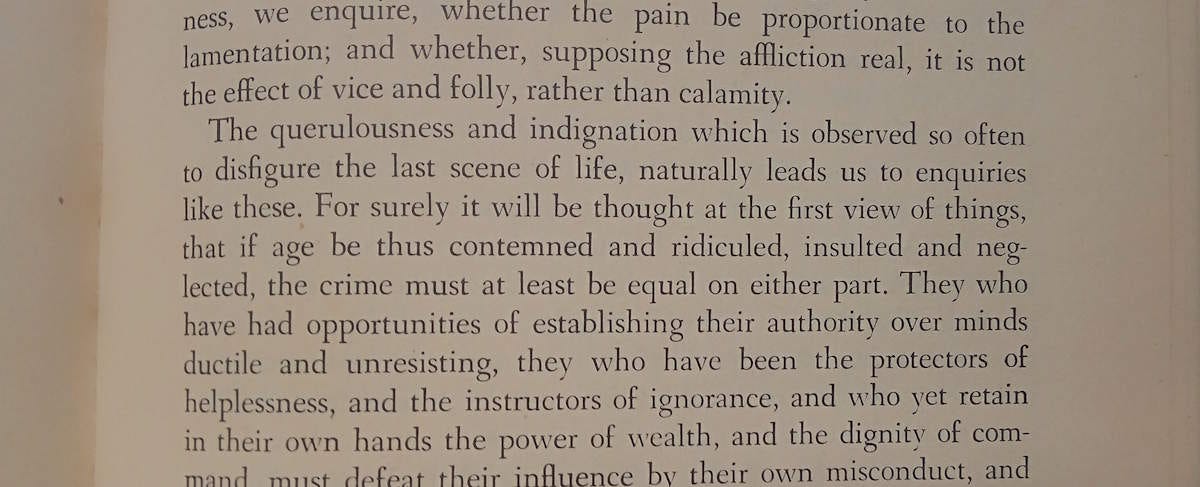
The querulousness and indignation which is observed so often to disfigure the last scene of life, naturally leads us to enquiries like these.
The book is Samuel Johnson: Rasselas, Poems, and Selected Prose, third edition, edited by Bertrand H. Bronson (Holt, Rinehart, and Winston, 1971).
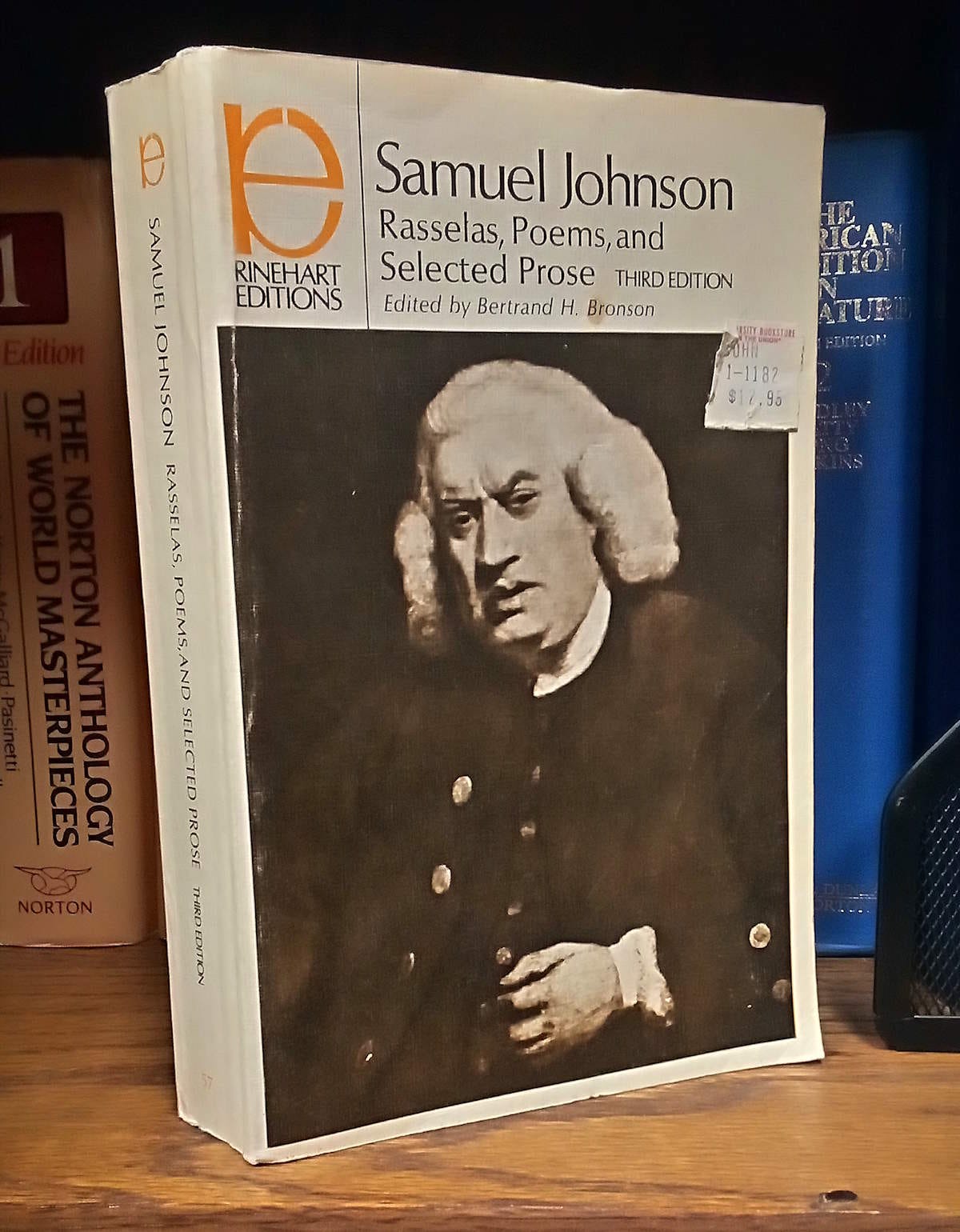
I confess that I have read hardly any of Johnson’s work, so little that I can’t even remember which essays, poems, or plays I may have encountered in excerpt back in college or during my own literary ramblings. (As you know if you’ve been following along for the past few days, this delivery of books and authors that I haven’t read before has established itself as a recurring motif throughout the exercise.) I know for certain that I’ve never read this particular essay.
When I briefly look to see the context, I find the line in question comes in the middle of Johnson’s essay “A Virtuous Old Age Always Reverenced,” in which he examines the mutual complaints of the old and the young about each other’s faults and the tensions that often mark relations between generations, particularly when old people complain about the moral decline of the next. “Every old man,” he writes, “complains of the growing depravity of the world, of the petulance and insolence of the rising generation. He recounts the decency and regularity of former times, and celebrates the discipline and sobriety of the age in which his youth was passed.” Such elders too often compare the “happy age” of their youth to a present where such happiness and virtue are “now no more to be expected, since confusion has broken in upon the world, and thrown down all the boundaries of civility and reverence.” But, Johnson suggests, this attitude may say more about the complainer than the thing complained of.
This is where today’s delivered passage comes in. Johnson notes that those in “the last scene of life” may simply be susceptible to a certain peevishness that “disfigures” their old age. In other words, it’s a more refined eighteenth-century version of today’s mocking criticism of old men yelling at the television. Maybe there’s nothing particularly wrong with the young. Or maybe they’re at least not wholly responsible for difficult inter-generational relations or a sad and declining state of the world. Maybe too many old people are just whiny, grumpy, and embittered. And maybe this actually contributes to the very conditions that they, with fatuous and mistaken self-righteousness, decry.
Remember when two days ago this bibliomantic experiment delivered up the dictionary definition of relation? Remember how that definition encompassed both the narrative meaning (“to relate a story”) and its kinship meaning (relationships among families and communities)? Here in today’s gleaning, Dr. Johnson is talking all about relation in both senses. He reflects on the difficulty of inter-generational relationships and the way it is at least partly the fault of those on the elder end of it when they give in to a grumpy, false, hypocritical, biased, and self-serving attitude that leads them to become unreliable storytellers about their own age.
To repeat what I’ve been saying and thinking for the past few days of this: Hmmm.
And what’s the connection to my own immediate circumstances or concerns? The answer at present is: still computing.
Those of you who are joining me in this exercise, please let me know your own textual gleanings for the day.
Warm regards,

A free online launch party for Writing at the Wellspring
Weirdosphere, the online learning community, will be hosting a free celebratory launch party for my new book Writing at the Wellspring on Sunday, December 14, at 3 p.m. EST, and all of you are cordially invited. I’ll read a short selection from the book, and then we’ll open things up for conversation on the creative daemon, writing as spiritual practice, the challenge of silence, and the path of living and writing into the dark.
The launch party is free, and Weirdosphere has created a special event space for it. To participate—and to show support for the book launch—simply follow the link below. You’ll be prompted to sign up for Weirdosphere and then register for the event:
This will be a casual gathering, so feel free to pop in and out as you wish. A recording of the event will remain available inside the event space for all registrants.
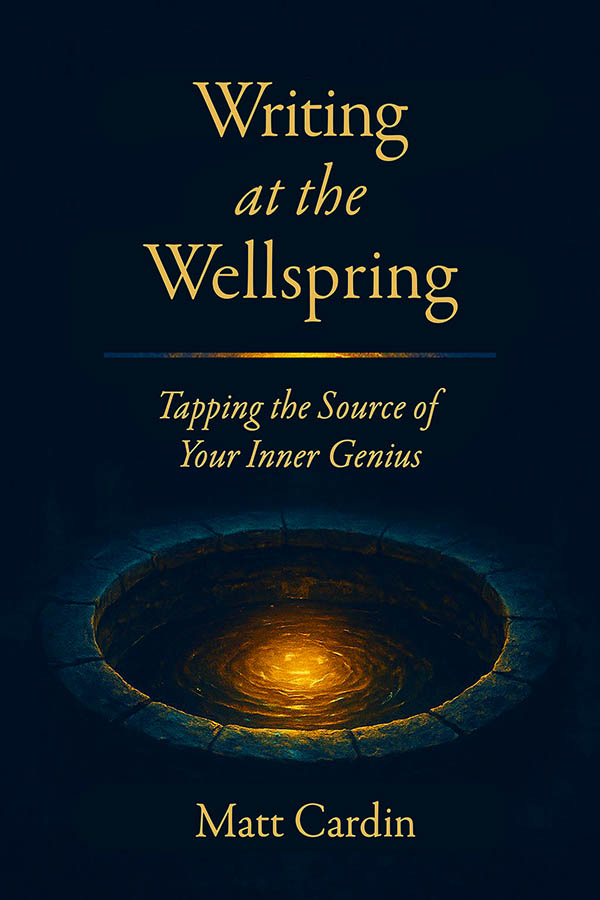
And remember: Writing at the Wellspring is now available for preorder in its Kindle edition, with both Kindle and print editions arriving on December 15.
“[An] intimate journey into the mystery of creativity and spirit… Cardin weaves practical methods, personal stories, literary references, and mystical insights into a lyrical meditation on what it means to create from the depths of the soul… both deeply personal and universally resonant.” — BookLife review (Publishers Weekly)
“A guide for writers who welcome the dark and hunger for meaning.
— Joanna Penn“I can’t think of any [other books] that link the creative act so uniquely or persuasively with spirituality.”
— Victoria Nelson“A meditation on the silence and darkness out of which all creative acts emerge....A guide for writers unlike any other.”
— J. F. Martel“Important to any writer ready to see through the self illusion and realize the freedom this brings to any creative work.”
— Katrijn van Oudheusden
Sorry I missed the post about what this experiment is about, as I am new to this site. This is a very enjoyable insight blog, thank you. I am not a writer, not a avid reader, but now under circumstances and need I hope to have time to persue this world a bit before I exit.
I am lagging behind on my own bibliomancy by 2 days. I will try and catch up tomorrow. Thanks for the invitation, too.