


Dear Living Dark readers,
Today, I want to commend to your attention a short story by Thomas Ligotti titled “Ghost Stories for the Dead.” Whether you’re already familiar with Ligotti or have never read his work, this is a powerful piece of fiction that, I predict, you may find deeply arresting.
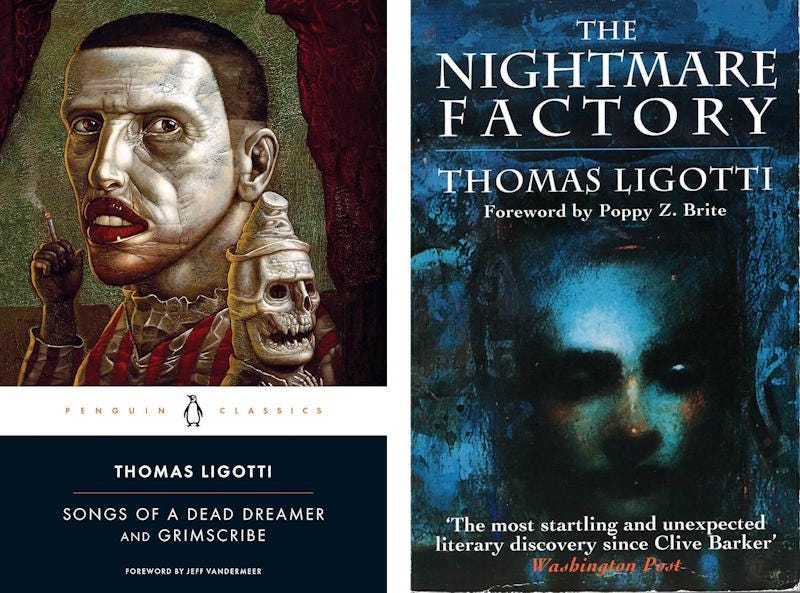
You won’t find it in Songs of a Dead Dreamer and Grimscribe, the combined 2015 Penguin Classics edition of Tom’s first two books, which were originally published separately in 1986 and 1991 and which were collections of stories that had previously appeared in the horror small press. Nor will you find it in any of his other collections—not Teatro Grottesco, and not even 1996’s The Nightmare Factory, which represented a nearly comprehensive omnibus of his fiction up to that time.
“Ghost Stories for the Dead” first appeared in 1982 in the second issue of author/editor Thomas Wiloch’s small press horror magazine Grimoire. It opens with an epigraph drawn from E. M. Cioran, a confirmed influence on Ligotti’s work and worldview: “That faint light in each of us which dates back before our birth, to before all births, is what must be protected if we want to rejoin that remote glory from which we shall never know why we were separated.” It then proceeds to tell a dark and reflective story, partly mournful and partly horrific, about the bliss of nonexistence as contrasted with the nightmarish agony of existence. Rather than unfolding as a conventional narrative, it is structured as a sequence of four short, thematically linked movements, each approaching the same central vision from a different angle:
The New Blackness
The New Silence
The Old Nonsense and the New
Tales of the New Dream
Across these sections, Ligotti contrasts the torments and absurdities of embodied existence with a strange, almost beatific condition of post-existence, where identity, memory, and suffering fall away into a state of absolute negation. But the story does not leave things there. In its final movement, it introduces a quiet but devastating reversal, one that suggests even this annihilating escape may not be secure.
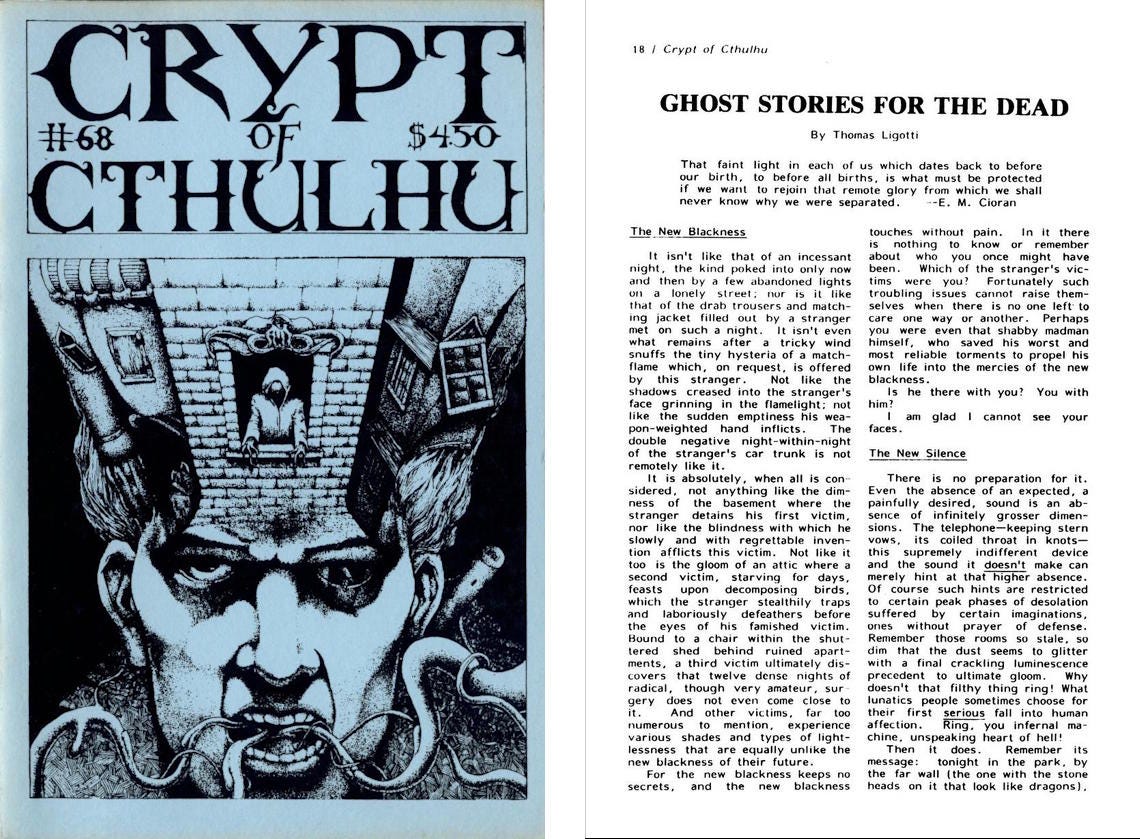
In 1989, seven years after its initial appearance, the story showed up again in the special all-Ligotti 68th issue of Crypt of Cthulhu. Then it was posted at Thomas Ligotti Online from 1998 to 2002.
And after that, it basically disappeared. As I mentioned, it has never been collected in any of Ligotti’s books, though it was included in a “collected short fiction” project—not carried out or authorized by Tom himself—that attempted to bring together all of his stories in chronological order.
I find this omission to be unfortunate and somewhat mystifying, as “Ghost Stories for the Dead” is simply brilliant, and also quite affecting in its signature combination of philosophical perspective, supernatural horror, and depressive gloom. If I were to assemble a list of my eight or ten favorite Ligotti stories, this would be among them. I don’t know why Tom has chosen not to include it in any of his fiction collections. I mentioned the story to him in 2006 when I interviewed him for my Teeming Brain blog (see “Interview with Thomas Ligotti: It’s All a Matter of Personal Pathology”), noting that it falls among the subset of his works that take a highly experimental approach and that convey plot only obliquely, opting instead to foreground his signature variety of horrific philosophical speculation. But I didn’t ask why he had chosen to leave it uncollected.
If you find anything enticing in this paean to a Ligottian literary rarity, be advised that you can read the story online, along with that entire issue of Crypt of Cthulhu, thanks to the Internet Archive.
As an accompanying note, and to expand on what I said at the start, I know many of you are interested in Ligotti’s writings, while I also know that some of you probably aren’t. Some of you may not even be familiar with his name, which is of course fine. Wherever you fall on that continuum of possibilities, I think this story will appeal if you appreciate short fiction that arrests and transports through a combination of philosophical vision and literary skill.
Thinking about the varying degrees of reader awareness toward Ligotti and his work leads me into a double-pronged digression, one having to do with the arc of his career and the other with my own history as a writer. As for the first, I still find Tom’s ascension or evolution from cult horror writer to mainstream literary figure to be somewhat hard to believe, even though it’s now a decade since that combined edition of Songs of a Dead Dreamer and Grimscribe from Penguin, followed by their publication of his nonfiction opus The Conspiracy against the Human Race three years later (in 2018), unofficially promoted him to the rank of canonical American author. And of course the famous (notorious) connection between his work and the pessimist/antinatalist worldview of the character of Rust Cohle, played by Matthew McConaughey, in the first season of HBO’s True Detective thrust him into the general public spotlight before either of the Penguin books appeared. Then there’s the fact that he had, in the 1990s, gone through a brief period of mass-market exposure and mainstream critical attention before returning to the world of small press horror that had been his original domain. It’s a striking trajectory.
As for my own writing, much of it has been integrally bound up with my love for Ligotti, whose work has always felt deeply personal to me, as in, personal in a way that’s specific to my own person. Those of us who had been transfixed for years by his writing, feeling it to be a priceless and somewhat private possession with its combination of cult status and life-changing power—it felt as if his stories, books, and interviews were speaking to each of us individually in the depths of our soul—found his transition to mainstream status to be a strange one indeed, something to be simultaneously celebrated and half-regretted, as if a precious secret were in danger of being denatured.
I came to Ligotti’s work myself at the very start of what I didn’t know would be something of an authorial career, and, as I’ve said, those two things were thoroughly enmeshed. My first published story was “Teeth,” which I had written two or three years before I first read Ligotti, and which readers later told me was suffused with a distinctly Ligottian vibe. Moreover, its first publication was at the brand-new website Thomas Ligotti Online in 1998, where I was an original member. I went on to write and publish more in the field of weird, cosmic, and supernatural horror, as my innate creative drive led me to produce stories that explored the dark depths where horror, religion, and art are different facets of the same spiritual jewel.
Then my daemon muse began leading me to branch out into writing about creativity itself in connection with the weird and spiritual, and eventually in connection with nonduality. But that didn’t mean I left horror completely behind. As the classic 1980s horror anthology television series Tales from the Darkside (which I have invoked here before) observed each week in its closing narration, “The darkside is always there, waiting for us to enter, waiting to enter us.” The dark is just as real as anything having to do with the light, of which it is the obverse face or facet, the inseparable alternate aspect. It will always be part of my writing. And, to return to the point, there continues to be no more profound or important body of work dealing with the darkness than that of Thomas Ligotti, for whom the darkness has been all-consuming, though not unleavened by a distinct dose of sharp wit and humor from time to time.
Early in my engagement with his work, right after I had read Grimscribe and Songs of a Dead Dreamer, I read “Ghost Stories for the Dead” and found it so very powerful, so very resonant with the deep fears, feelings, and fascinations that defined my sensibility. For me it occupies a special place. And that’s why I’m bringing it to your attention now.
In parting, here’s a taste of its actual text to further whet your appetite. This comes from its closing words, which may haunt you, not like a specter that threatens from the outside, but like one that lives inside your own self:
For in the new dream such beings—wrenched from eternity and returned to earth—are capable of anything from indiscretion to atrocity. Those who have suffered most know how to inflict it best—it’s a law of the universe. The suicides, the murdered . . . the unfulfilled, the broken hearted: veterans of extraordinary suffering and mercenaries of its perpetuation.
These are my mind’s eyes, I who have no eyes. These are my mind’s mind, I who am not mind. I am bereft of traits, bankrupt of qualities. The riches of the dead are extravagant next to my destitute estate. I have nothing but my immortality; and now, desiring or not, they will have it too.
And I am glad I cannot know them.
But I am even gladder they cannot know me.
Warm regards,

The Living Dark is free to all readers. If you find value here, a paid subscription or one-time donation helps sustain the work. Paid subscribers receive access to the full archive plus the quarterly Living Dark Reader, a PDF journal for slow reading and reflection.
Some of the book links here are affiliate links to Amazon or Bookshop.org, which means I’ll earn a commission if you click through them and buy anything.
The inner work of the creative life:

READER REACTIONS:
“It easily earns its place on my shelf of texts that have challenged and changed how I think about writing and the creative life.”
“What I’m thoroughly enjoying is the way Matt Cardin weaves those deep, existential questions in and out of the practical, grounded realities of writing itself … This is a book that doesn’t just talk about creativity; it inhabits it.”
“Matt has put into words things that have been alive in me for a long time, but which I have never articulated myself.”
“There is potential here to change your life … Cardin’s writing stirred something dormant in me.”
“This is definitely more than a self-help book on creativity. Matt Cardin’s range of scholarship, casual reading, philosophical spelunking and theological scholarship here forms into one single vision…If Colin Wilson and Krishnamurti and ST Joshi had written a tome on the essentials of creativity, it would be something like this.”
“It was incredible finding an author able to describe how to unlock the skills I’ve been working on even further.”
“This book is by far the best book I have read on creativity. I hope it will reach many people and help them freed from creative block, procrastination, paralyzing self-doubt, and perfectionism.”
“This isn’t a how-to book about writing. It’s a book about why writing matters, and what it’s actually touching when it’s real.”
ADVANCE PRAISE:
“[An] intimate journey into the mystery of creativity and spirit… Cardin weaves practical methods, personal stories, literary references, and mystical insights into a lyrical meditation on what it means to create from the depths of the soul… both deeply personal and universally resonant.”
— BookLife review (Publishers Weekly)
“A guide for writers who welcome the dark and hunger for meaning.
— Joanna Penn, author of Writing the Shadow
“I can’t think of any [other books] that link the creative act so uniquely or persuasively with spirituality.”
— Victoria Nelson, author of On Writer’s Block and The Secret Life of Puppets
“A meditation on the silence and darkness out of which all creative acts emerge....A guide for writers unlike any other.”
— J. F. Martel, author of Reclaiming Art in the Age of Artifice and co-host of Weird Studies
“Important to any writer ready to see through the self illusion and realize the freedom this brings to any creative work.”
— Katrijn van Oudheusden, author of Seeing No Self
I discovered the Nightmare Factory in the 90s, exhumed from a pile at the end of a dusty horror aisle in a used bookstore; or rather, it found me, with that fantastically inviting title, cover, and Poppy Z. Brite intro. I still have that copy. And I've been a Ligotti fan ever since (the Vastarien journal was fantastic).
So I am super excited to read this story! Thanks so much for the introduction.
I know his name but cannot recall if I've read him - I've read a lot of fictional horror over the years but my penchant for forgetting author's names is unsurpassed.
The approach makes me think of the early Gnostics and their demiurge - not a benevolent creator, but a planetary Demon...rather like Saturn or Kronos - trapping pure Soul in the confines of materiality.
One thinks of the newly born - fresh, innocent and already primed to grow...to exist - the drive to thrive. Then commences the forging of an ego to survive the inevitable wounding, onward to aging, loss of faculties, and the final dissolution of everything the living believe to be important.
It sounds like Ligotti and much of horror fiction reflects the story currently unfolding in our world - where monsters in human form lust for power and supremacy in a parody of the Demiurge, upheld by barbarous throngs who believe in the salvation of lies.