

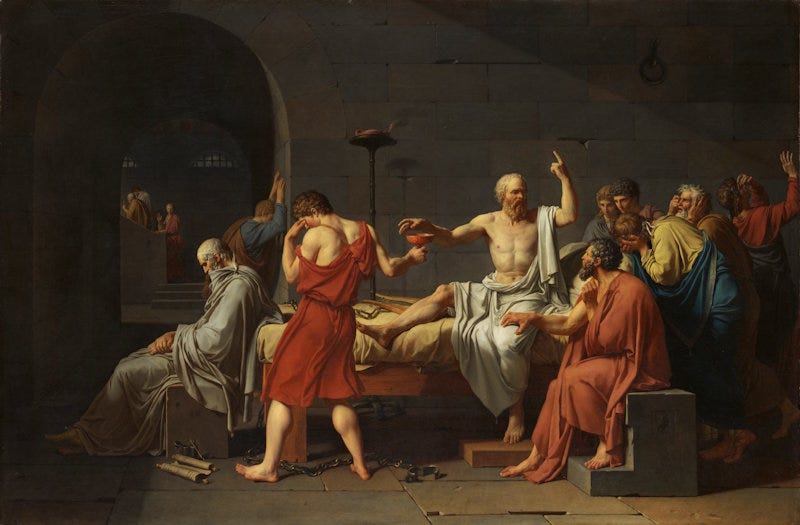
Dear Living Dark readers,
I’ll break convention by starting this post right out of the gate with someone else’s words instead of my own:
Socrates was content to refute everyone else’s positions while affirming nothing concrete himself, meaning that his philosophical heirs do a lot of performative contradiction, which is not sufficient. Nor is what we like to call ‘the Socratic method’—teaching by asking questions until students produce the correct answers—what Socrates had in mind. Such attempts to mimic him miss the point, which is that true thinking should be dangerous to your intellectual equilibrium. It should strive for answers that overthrow the terms of the question being asked, not simply prove a point.
It’s impossible to convey the extent of my delight at this opening salvo from Laura Kipnis’s review, published last year in The New Republic, of Agnes Callard’s Open Socrates: The Case for a Philosophical Life. Though I don’t talk about Socrates all that often, he has been an iconic figure to me in a deeply personal way ever since I discovered him in my late teens. And this brief summation of Callard’s overall point about him goes a long way toward articulating what I have always felt is the beating heart of both his general importance and his deep appeal to me personally. It’s an appeal that has shaped my inner life, my understanding of how I interact with others, and the way I approached my teaching career for eighteen years in the classroom.

A bit more from Kipnis’s review:
We’re not born with the knowledge of how to live, yet we want to live lives that make sense—that’s what it is to be human, Callard and Socrates believe. But we spend most of our lives floundering around, improvising stopgap solutions. Philosophy is the answer to this need.
The method Callard proposes to achieve the requisite self-knowledge to lead a meaningful life is the “untimely question.” “There’s a question you are avoiding,” is the book’s opening line. “Even now, as you read this sentence, you’re avoiding it.” The good news is that the resistances we organize our lives around are actually the paths to truth and wisdom. The bad news is that we assiduously evade taking them, feigning busyness and obligations as avoidance strategies. . . .
If we need to believe in the choices to which we’re committing at the very minute we’re committing to them, the impossibility of the untimely question is that, by definition, it comes too late: You’re already using the answer to lead your life. The only way to freely answer the untimely question is to saw off the branch on which you’re standing.
And on the value of philosophical conversation, of having someone else with whom to reflect on all these things:
[T]he operative question is: To what extent can we really see ourselves? Are we in some inbuilt way “self-blind”?—after all, the eye can’t see itself. Which is why thinking is a two-person job, in the Socrates-Callard view. . . .
[S]ince none of us can subject our “load-bearing” beliefs to sufficient evaluation on our own, we need the help of others to clarify our beliefs: “Refutation cures normative self-blindness.”
By the by, the whole concept of “the untimely question” brings up, for me, a resonant comparison with something David Carse returns to repeatedly in Perfect Brilliant Stillness regarding the single, profound, devastating question that we each carry deep within—a question that’s unique to each of us, the very asking of which will utterly undo the house of cards that we have built up and come to regard as “ourselves.” “If you’re going to ask questions,” says Carse, “ask . . . the hard questions, the questions that take you out of anything you have ever known, the questions that could end your life.”
Here are a couple of other passages where Carse elaborates:
The ego sense of self spends all its time trying to stay in control, and that means trying to keep you away from these moments of disorientation when the bottom drops out and it doesn’t know what to do. This is so beautiful. This is what I mean when I talk about asking the dangerous question, the question that may end your life. This idea that this “you” is not real, is only a thought, a projection, stop[s] you. That’s why I [say] to savor that feeling of disorientation. Get to know it, to not fear it, to welcome it. . . .
Be aware that what form this will take is not up to you, and that it may take “time.” It may take a lifetime, may take more than a lifetime. It doesn’t matter. Let yourself be brought to a place where it doesn’t matter. In stillness, find yourself asking the dangerous question, the question that the ego does not want you to think of, the question that will end your life.
What Carse is getting at in these passages is not, of course, precisely identical to what Callard talks about in relation to Socrates. Carse is speaking within the field of Eastern-oriented nondual spirituality, while Callard is speaking within the field of Western philosophy. But I’ll go out on a limb by asserting that both are aimed, ultimately, at the same thing, and that both manifestly carry the same general spirit. I would also wager that both approaches will wind up—again, ultimately—with the same result.
This also says something of profound and pointed importance about the very nature of the Socratic/Western and nondual/Eastern approaches to understanding your life and the world, and to uncovering the whole point by answering the question that has been given to you by the very fact of your birth and presence.
It seems I have a new book to read. I’m surprised that this is the first time I have heard of Callard, a philosopher, professor, and provocateur who, as I’m now learning, has been on the scene for quite some time, and for whom the adjective “colorful” sounds inadequately extravagant. In any case, maybe my spirit of energetic interest has passed itself along to you as well. Let me know if you, too, find this all intriguing. Especially let me know if you read Kipnis’s review and/or Callard’s book. I’d love to hear your impressions of both.
Warm regards,

PS. The book links in this post are affiliate links to Bookshop.org, so I’ll earn a commission if you click through and buy something.
The Living Dark is freely published. If you find value here, a paid subscription or one-time donation helps sustain the work.
Published in December:

READER REACTIONS:
“It easily earns its place on my shelf of texts that have challenged and changed how I think about writing and the creative life.”
“What I’m thoroughly enjoying is the way Matt Cardin weaves those deep, existential questions in and out of the practical, grounded realities of writing itself … This is a book that doesn’t just talk about creativity; it inhabits it.”
“Matt has put into words things that have been alive in me for a long time, but which I have never articulated myself.”
“There is potential here to change your life … Cardin’s writing stirred something dormant in me.”
“This is definitely more than a self-help book on creativity. Matt Cardin’s range of scholarship, casual reading, philosophical spelunking and theological scholarship here forms into one single vision…If Colin Wilson and Krishnamurti and ST Joshi had written a tome on the essentials of creativity, it would be something like this.”
“It was incredible finding an author able to describe how to unlock the skills I’ve been working on even further.”
“This book is by far the best book I have read on creativity. I hope it will reach many people and help them freed from creative block, procrastination, paralyzing self-doubt, and perfectionism.”
“This isn’t a how-to book about writing. It’s a book about why writing matters, and what it’s actually touching when it’s real.”
ADVANCE PRAISE:
“[An] intimate journey into the mystery of creativity and spirit… Cardin weaves practical methods, personal stories, literary references, and mystical insights into a lyrical meditation on what it means to create from the depths of the soul… both deeply personal and universally resonant.”
— BookLife review (Publishers Weekly)
“A guide for writers who welcome the dark and hunger for meaning.
— Joanna Penn, author of Writing the Shadow
“I can’t think of any [other books] that link the creative act so uniquely or persuasively with spirituality.”
— Victoria Nelson, author of On Writer’s Block and The Secret Life of Puppets
“A meditation on the silence and darkness out of which all creative acts emerge....A guide for writers unlike any other.”
— J. F. Martel, author of Reclaiming Art in the Age of Artifice and co-host of Weird Studies
“Important to any writer ready to see through the self illusion and realize the freedom this brings to any creative work.”
— Katrijn van Oudheusden, author of Seeing No Self
This reminds me of Sperber & Mercier's psychological work on what they called "the argumentative theory of reasoning," where they claimed that we didn't evolve to examine our own views but those of our fellow humans, as a form of self-defense against in-group manipulation.
https://sites.google.com/site/hugomercier/?pli=1
This is wonderful -- a crucial movement, in which the question reaches behind the questioner: the movement of Christian recollection, as one's Lord is what is real in one; in Gurdjieff, self-remembering; in Heidegger, the question of Being...