


Dear Living Dark reader,
The week-long experiment continues with another gleaning or delivery from a randomly chosen book. As before, see the Day One post for an explanation of what this series is about and how I’m approaching the writing of it.
After two installments of seeing the bookshelf in my college office hand up plays to serve as the substance of the day’s bibliomantic divinations (A Midsummer Night’s Dream on Day One and The Crucible on Day Two), the book that presented itself for this third installment represents a distinct departure. It’s not a play, and in fact not a literary work at all, but a reference volume. And yet I can still see an immediate resonance between the content of today’s “message” and what came up on those previous days. Here’s the gleaning:
relation (ri lā’ shən) n. ⟦ME relacion < MFr or L: MFr relation < L relatio: see RELATE⟧ 1 a narrating, recounting, or telling 2 what is narrated or told; account; recital 3 connection or manner of being connected or related, as in thought, meaning, etc. 4 connection of persons by blood, marriage, etc.; kinship 5 a person connected with another or others by blood, marriage, etc.

The source is Webster’s New World Dictionary, Third College Edition.

I have to say that I find this a rather striking result, coming on the heels of the first two days, as the multiple meanings of the word “relate” are definitely relevant to those previous deliveries. The first day brought lines from Puck’s closing speech in A Midsummer Night’s Dream, where he broke the fourth wall and urged the audience, if they felt offended by the play they had just watched, to regard it as a mere dream. The second day brought lines from Act Two of The Crucible, from a scene where John Proctor finds himself in legal hot water for having erupted in fury when his wife Elizabeth was falsely arrested on charges of witchcraft.
Puck’s speech foregrounds the diaphanous division between dreams and waking reality, calling both into question. Proctor’s court appearance, as I’ve just learned by reading up on it, is all about clashing versions of the truth, focusing on the power of story—of narrative—to override reason and destroy people’s lives once they’ve believed it. Both plays invoke a self-conscious consideration of the power of storytelling to shape what counts as “truth.” But whereas Shakespeare suggests that dream truth and waking truth may be intermingled in the act of storytelling, blurring the boundary between illusion and reality, Miller presents a more tragic situation in which the truth is clear, and the audience knows it, and yet all they can do is watch helplessly as that truth is smothered by communal hysteria and self-deception. Shakespeare calls out the ontological mystery of what we mean by “truth,” whereas Miller calls out the social construction of “truth” and the way this process can go horrifically awry. And both turn on the question of how truth is related, as in told. And also the relationships among the characters in the plays, as well as the relation between a play and its audience.
So, in sum: Hmmm.
I can already tell that, aside from any other benefits this exercise may or may not deliver, one is this: I’m now definitely motivated to read The Crucible in 2026.
On a more personal note, the dictionary that presented itself to my blindly reaching hand today is one that has accompanied me for some 37 years. This third edition was published in 1988, the year I graduated from high school. If I recall correctly, it was gifted to me during my freshman year of college. It has been a fixture on my bookshelves, first at home and now in my college office, for all this time, following me around Missouri, and to Texas, and now to Arkansas, and remaining a textual presence through shifting seasons of family, career, and the various vagaries of inner and outer life.
I’ll return tomorrow for Day Four. In the meantime, I invite you to keep playing along, if you’re so motivated, by sharing your own Day Three divination in the comments.
Warm regards,

The Kindle edition of Writing at the Wellspring is available for preorder. Much of its content was first published here at The Living Dark in a different form. Whether you’ve known my work for years or are just coming across it, this book brings together my thinking about creativity, inner silence, the daemon muse, and the strange, life-shaping currents beneath inspiration. It’s part craft, part philosophy, and part spiritual manifesto.
If this resonates, know that preorders genuinely help a new book reach the readers who might need it. December 15 is the release date for both print and electronic editions.
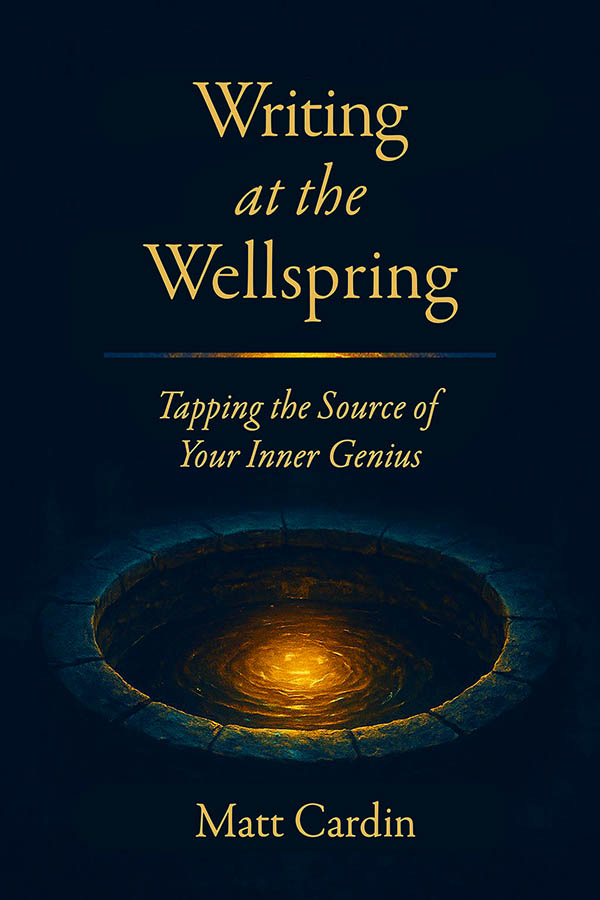
“[An] intimate journey into the mystery of creativity and spirit… Cardin weaves practical methods, personal stories, literary references, and mystical insights into a lyrical meditation on what it means to create from the depths of the soul… both deeply personal and universally resonant.” — BookLife review (Publishers Weekly)
“A guide for writers who welcome the dark and hunger for meaning.
— Joanna Penn“I can’t think of any [other books] that link the creative act so uniquely or persuasively with spirituality.”
— Victoria Nelson“A meditation on the silence and darkness out of which all creative acts emerge....A guide for writers unlike any other.”
— J. F. Martel“Important to any writer ready to see through the self illusion and realize the freedom this brings to any creative work.”
— Katrijn van Oudheusden
I am loving this exercise so far! If I may share, what I’m seeing is a question of the shadow, the story the shadow carries, and what happens when we relate to it (as Puck says, it was a dream) and when we do not relate to it (the horror of The Crucible).
Additionally, a “crucible” is how we hold the shadow and refine it. AND the video you chose for day one, from Dead Poets, shows another kind of shadow unrelated to, the one that ends that movie so tragically (which that scene sets up).
Can’t wait to see what’s next!
My day 3 is from Substack today by SLAVOJ ŽIŽEK on his ŽIŽEK GOADS AND PRODS:
3). Perhaps the lesson to be learned is that, sometimes, a dose of alienation is indispensable for the peaceful coexistence of ways of life. Sometimes alienation is not a problem but a solution.