

Dear Living Dark readers,
For the past month, I have been hard at work on the second issue of The Living Dark Reader. And stemming from that, I want to say this:
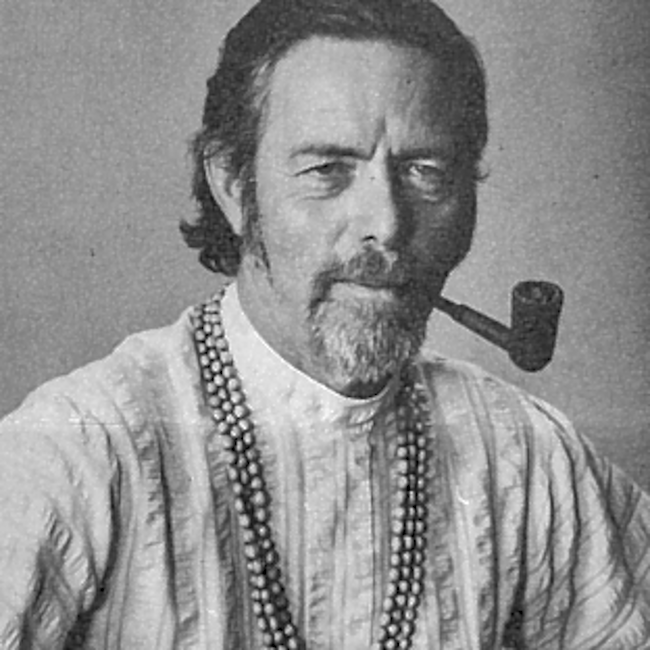
Alan Watts’s project in Beyond Theology was to reinterpret Christian theology through the lens of Advaita Vedanta, the Hindu philosophical tradition whose central insight is famously expressed in the eighth-century philosopher Sankara’s formulation: “Brahman is real, the world is false, the individual self is only Brahman, nothing else.” Brahman, in this framework, is the universal, central self whose divine dreaming gives rise to all finite selves and the cosmos in which they exist. These selves and their lives are real, but they are real as dreams, as projections of Brahman into the play of finite existence, which the tradition calls lila, the divine game or dance, unfolding within maya, the dream or illusion of space, time, and separate identity.
Within this outlook, Watts found a warrant for appreciating the Christian experience of alienation and longing in a new light. The individual self’s sense of lostness, incompleteness, and yearning for something beyond itself becomes, in his reading, the experience of Brahman dreaming itself so deeply into finite form that it temporarily forgets its own nature: “If … the Christian imagery is set within the context of the Hindu, the razor-edge path between salvation and damnation, with all the magnificent and appalling consequences this illusion has had for mankind, becomes one of the greatest dramatic situations of all time,” because it illustrates how deeply Brahman can allow itself to become lost in its dream, even to the point of forgetting that it is dreaming and that it therefore possesses the power to awaken.
The experience of individuated selfhood thus becomes, in Watts’s formulation, “a dream that I am not dreaming at all, that I will never wake up, that I have completely lost myself somewhere down the tangled corridors of the mind, and, finally, that I am in such excruciating agony that when I wake up, it will be better than all possible dreams.” In other words, it becomes the dream of the wholly alienated Christian creature-self, lost in a vale of tears and anxiously longing for the inconceivable bliss of Paradise, to be known in the hereafter by those who have been saved through Christ.
It is out of this schema, and specifically out of a model of human individuality as “two spheres with a common center,” the outer sphere being the conscious ego and the inner sphere being the real self that the ego has forgotten, that Watts’s description of a primal human longing emerges. This longing, in his reading, is the inevitable epiphenomenon of a consciousness that has temporarily forgotten what it most deeply is, and that sometimes, in certain rare and luminous moments, it half-remembers:
This fantasy religion would then require the final condition that at some time the two spheres would merge, that my inmost Self would awaken from its dream to transform my superficial ego with a shock of recognition. Perhaps this is why we sometimes have a strangely pleasant sensation of having forgotten something extremely important from long, long ago. Occasionally, this shadow of a memory comes with hints of a forgotten paradise, some luminous landscape of hills and waters which is utterly familiar and yet completely unidentifiable. Every now and then the “real” world reminds us of it, and we think, “This is what I have always been looking for. This place feels like home.” At other times, the memory has a much deeper dimension—a sensation of being immeasurably ancient and knowing, as somehow prior to time and space. But there is nothing at all specific about it, for though the sensation is vivid, it is tantalizingly ephemeral. These are, then, intimations of something to be remembered which is, as it were, a vast dimension of one’s being which has been kept hidden—perhaps from the moment of birth. For consciousness, or conscious attention, is the trick of noticing the figure and ignoring the background, and in the same way I seem to notice my ego and forget my background, the larger Self which underlies my ego.
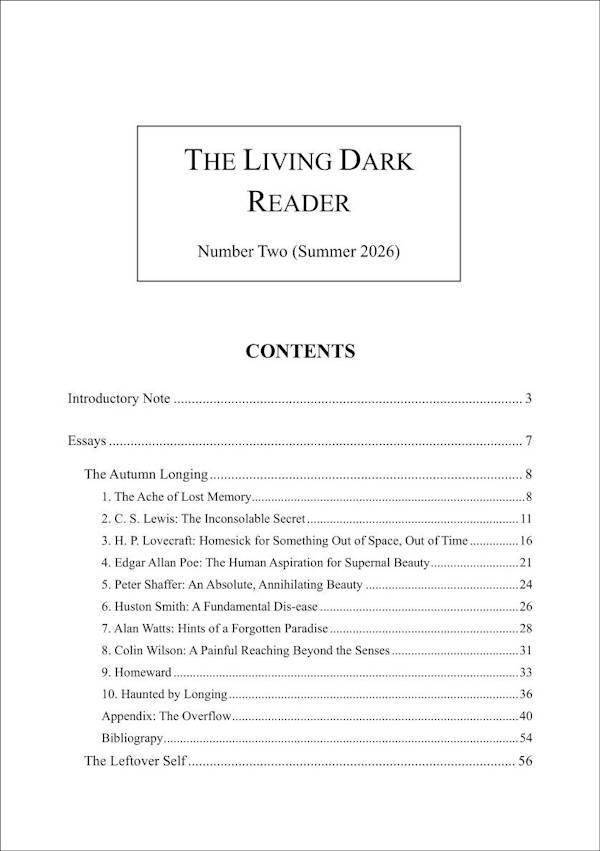
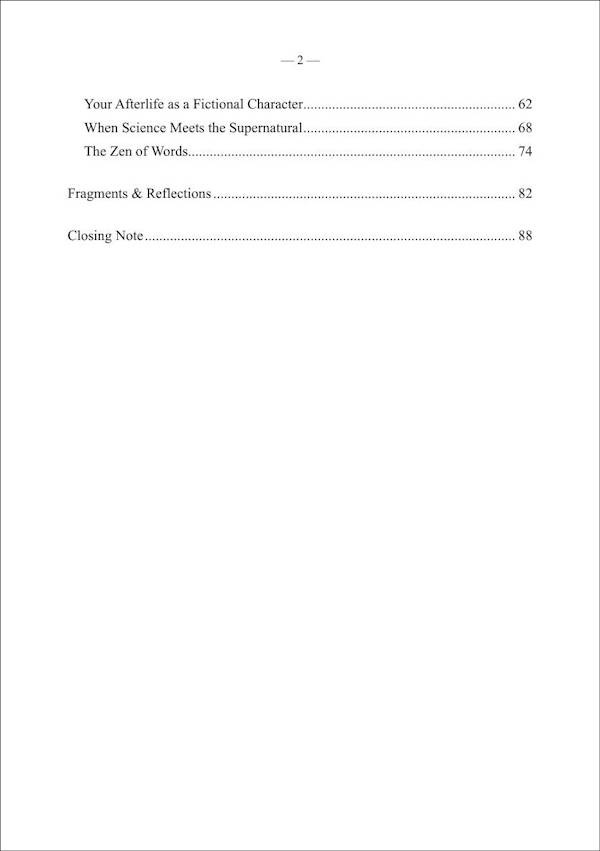
The above paragraphs come from the appendix to the lead essay in that forthcoming Living Dark Reader, titled “The Autumn Longing.” I’ll be publishing the issue here for paid subscribers on June 15. The table of contents is as follows, though the page numbers may end up shifting slightly based on final edits that I’m currently performing:
That’s all for now. I’ll talk to you again in a few days.
Warm regards,

The inner work of the creative life:


PRAISE:
“[An] intimate journey into the mystery of creativity and spirit… Cardin weaves practical methods, personal stories, literary references, and mystical insights into a lyrical meditation on what it means to create from the depths of the soul… both deeply personal and universally resonant.” — BookLife review (Publishers Weekly)
“A guide for writers who welcome the dark and hunger for meaning. — Joanna Penn, author of Writing the Shadow
“I can’t think of any [other books] that link the creative act so uniquely or persuasively with spirituality.” — Victoria Nelson, author of On Writer’s Block and The Secret Life of Puppets
“A meditation on the silence and darkness out of which all creative acts emerge....A guide for writers unlike any other.” — J. F. Martel, author of Reclaiming Art in the Age of Artifice and co-host of Weird Studies
“Important to any writer ready to see through the self illusion and realize the freedom this brings to any creative work.” — Katrijn van Oudheusden, author of Seeing No Self
READER REACTIONS:
“It easily earns its place on my shelf of texts that have challenged and changed how I think about writing and the creative life.”
“One of those magical texts that voices the Truth I secretly always knew.”
“What I’m thoroughly enjoying is the way Matt Cardin weaves those deep, existential questions in and out of the practical, grounded realities of writing itself … This is a book that doesn’t just talk about creativity; it inhabits it.”
“Matt has put into words things that have been alive in me for a long time, but which I have never articulated myself.”
“There is potential here to change your life … Cardin’s writing stirred something dormant in me.”
“This is definitely more than a self-help book on creativity. Matt Cardin’s range of scholarship, casual reading, philosophical spelunking and theological scholarship here forms into one single vision … If Colin Wilson and Krishnamurti and ST Joshi had written a tome on the essentials of creativity, it would be something like this.”
“It was incredible finding an author able to describe how to unlock the skills I’ve been working on even further.”
“This book is by far the best book I have read on creativity. I hope it will reach many people and help them freed from creative block, procrastination, paralyzing self-doubt, and perfectionism.”
“This isn’t a how-to book about writing. It’s a book about why writing matters, and what it’s actually touching when it’s real.”
My dear I haven't taken a read yet, but I just know you are a genius. I miss you
So incredibly relevant for me, as my partner is lost in some other frame of time with what is casually referred to as dementia. He lives in a blur of memories and dreamlike experiences which cause him terrible conflict - he "knows" this is happening but can do nothing to stop it. He is driven into panic - he wants to go "HOME".....and I go with him into this storm - it is all I can do - stay beside him. I am the last constant thing in his life, and I will not allow any "outsider" into this intimate space. We are One...alone against a backdrop of mundanity which continues like a weird noisy movie playing. That background is where well-meaning friends and neighbours warn me "I risk collapse if I don't allow support ". They think holding it all together is somehow dangerous - but I am finding it quite the contrary - I am on a bridge between the dream of existence and something much greater. It is awesome and terrifying, and my preview of something beyond the scratchings of my singular dreams of time and experience. My love for my partner is what has placed me firmly in this terrifying and awesome powerlessness. It has been the glue of 50 years of adventures...of loss, achievement, joy and sorrow - all passing by in this present point of time like a wave rushing to a shore - towards "Home"