

Dear Living Dark reader,
The idea came to me this morning, quite literally from (seeming) nowhere, to do seven days of bibliomancy, and then to sew all the passages together at the end of that time and read them as a single, sustained “message.” And also to do this publicly. I have no idea if it will amount to anything worthwhile or even interesting. Having said that:
Bibliomancy, as you may know, refers in its simplest form to seizing upon a random (to the conscious mind) piece of writing—a book, an essay, a poem, an article, the back of a soup can, a scrap of newspaper fluttering down the street—and reading a randomly selected portion of the text. Then you reflect on the passage to see if and how it relates to, and potentially illuminates or comments on, your present circumstances and concerns. It’s essentially a free-form mode of divination using any available written text instead of something formally dedicated to that purpose like the Tarot or the I Ching.
I first encountered the basic idea of bibliomancy, though without that name attached to it, in the works of Richard Bach. In high school, after reading Jonathan Livingston Seagull in a modern lit class where we had some freedom to choose our own books, I went on to read Bach’s Illusions: The Adventures of a Reluctant Messiah, which proved exceedingly important to me. I’ll let you look it up if you’re not already familiar with it, but one prominent element in that book is a “messiah’s handbook” that one of the two main characters—Don Shimoda, the reluctant messiah of the title, who had quit the job because of the constant pressure of bustling and uncomprehending crowds—gives to the protagonist, a slightly fictionalized version of the author.
The handbook contains pithy sayings on each page that are billed as “reminders for the advanced soul.” Richard browses through it with excitement and sees there are no page numbers. Shimoda explains, and his words convey the essence of bibliomancy in a nutshell. Here’s the whole passage:
I noticed something strange about the book. “The pages don’t have numbers on them, Don.”
“No,” he said. “You just open it and whatever you need the most is there.”
“A magic book!”
“No, you can do it with any book. You can do it with an old newspaper, if you read it carefully enough. Haven’t you done that, hold some problem in your mind, then open any book handy and see what it tells you?”
“No.”
“Well, try it sometime.”
As I’m sure you can see, such an experiment is heavily reliant on a sense of, and belief in, synchronicity—on the idea that there’s an intelligence, call it reality’s algorithm if you like, that operates not just in subjective space but in the objective world as well, bridging or uniting inner and outer experience in meaningful ways. It’s also entirely resonant and consonant with the Modernist and nascent Postmodernist sensibility that characterized and drove the work of figures like Jackson Pollock and John Cage, leading them to rely on the embedded intelligence of the universe in making their art, where they meant to let that intelligence express itself.
For this mini-project, I’ll be using for my subject matter the bookshelf in my office at the college where I work:
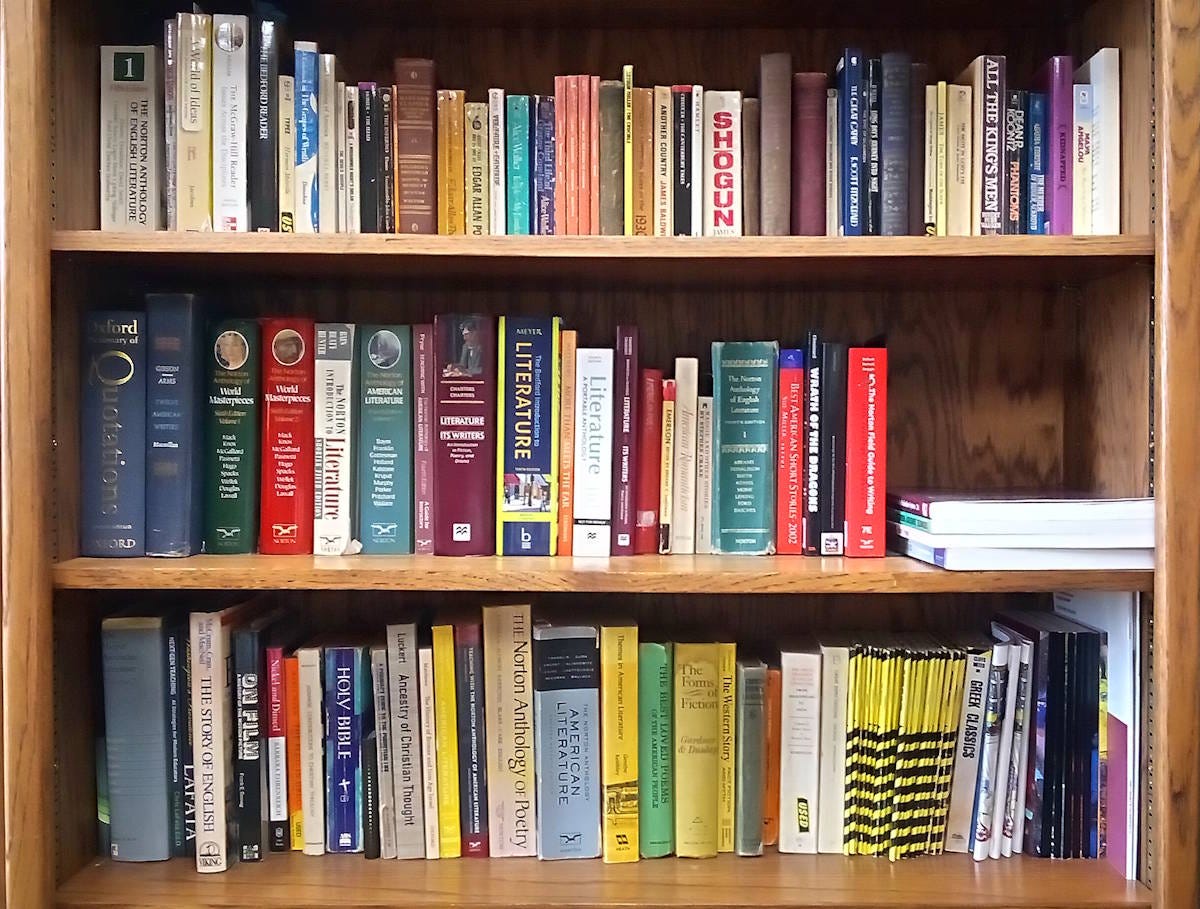
The shelf contains a small library of various texts that I’ve amassed over the past four-plus years. Some I brought from home. Others I gained from cast-offs in our English department. Others were here when I arrived and inherited the space. A few were given to me by their authors, including academic colleagues both here and at another institution.
My process will be to stand before these shelves, close my eyes, reach out as randomly as I can with either hand, grab whatever book presents itself, riffle randomly through the pages to one that chooses to stay open, put my index finger down at a random spot, and then open my eyes and read what’s there, ending at whatever point seems like a natural round-off. Then on December 12 or thereabouts, I’ll put everything together in a Living Dark post to see what they add up to, if anything.
In presenting each day’s textual passage, I’ll leave the interpretive commentary about any relationship to my current inner or outer life to write itself spontaneously—or not.
So, with all that introductory throat-clearing accomplished, here’s the passage that presented itself today, on Day One:
          If we shadows have offended,
          Think but this, and all is mended,
          That you have but slumb’red here
          While these visions did appear.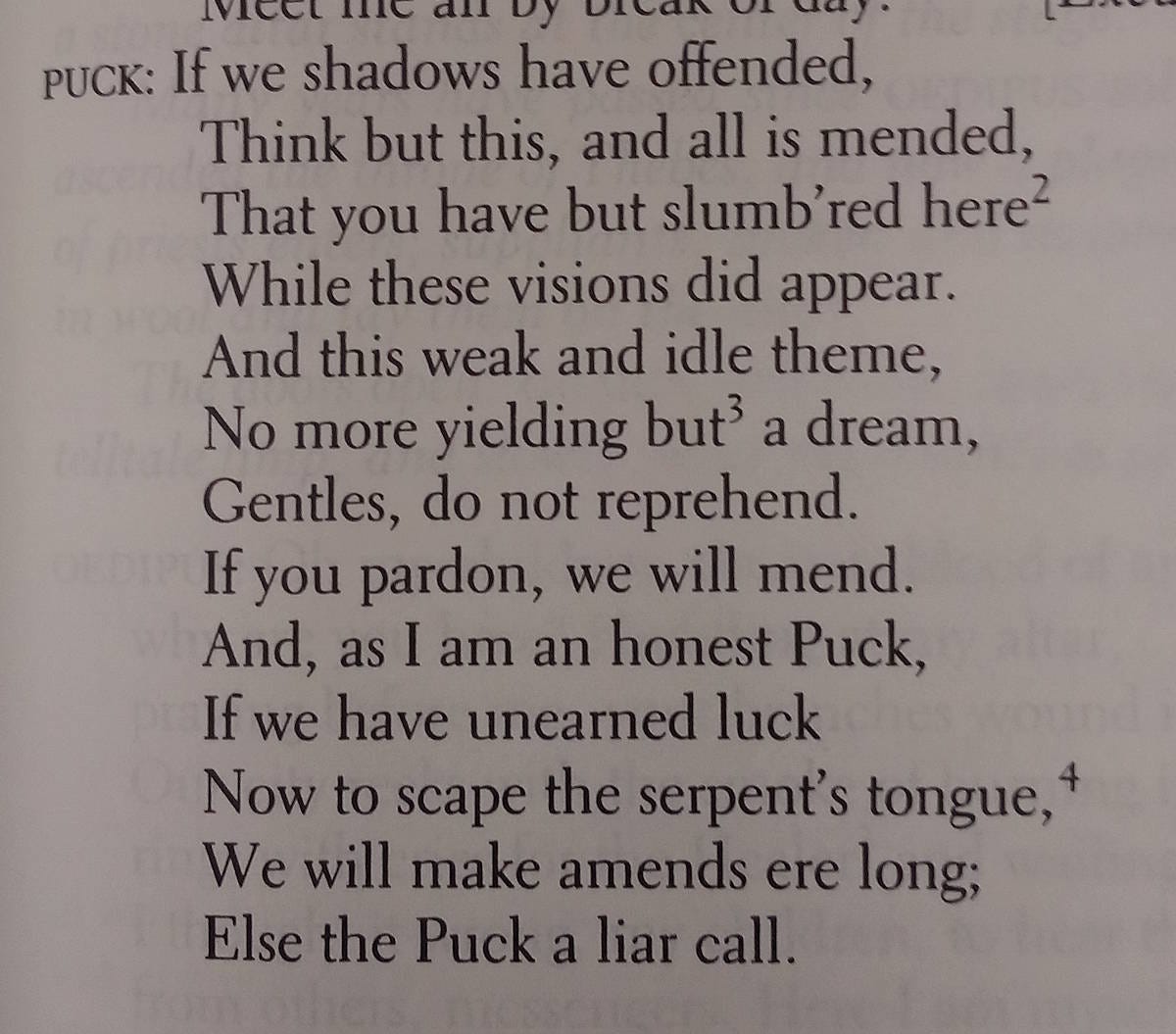
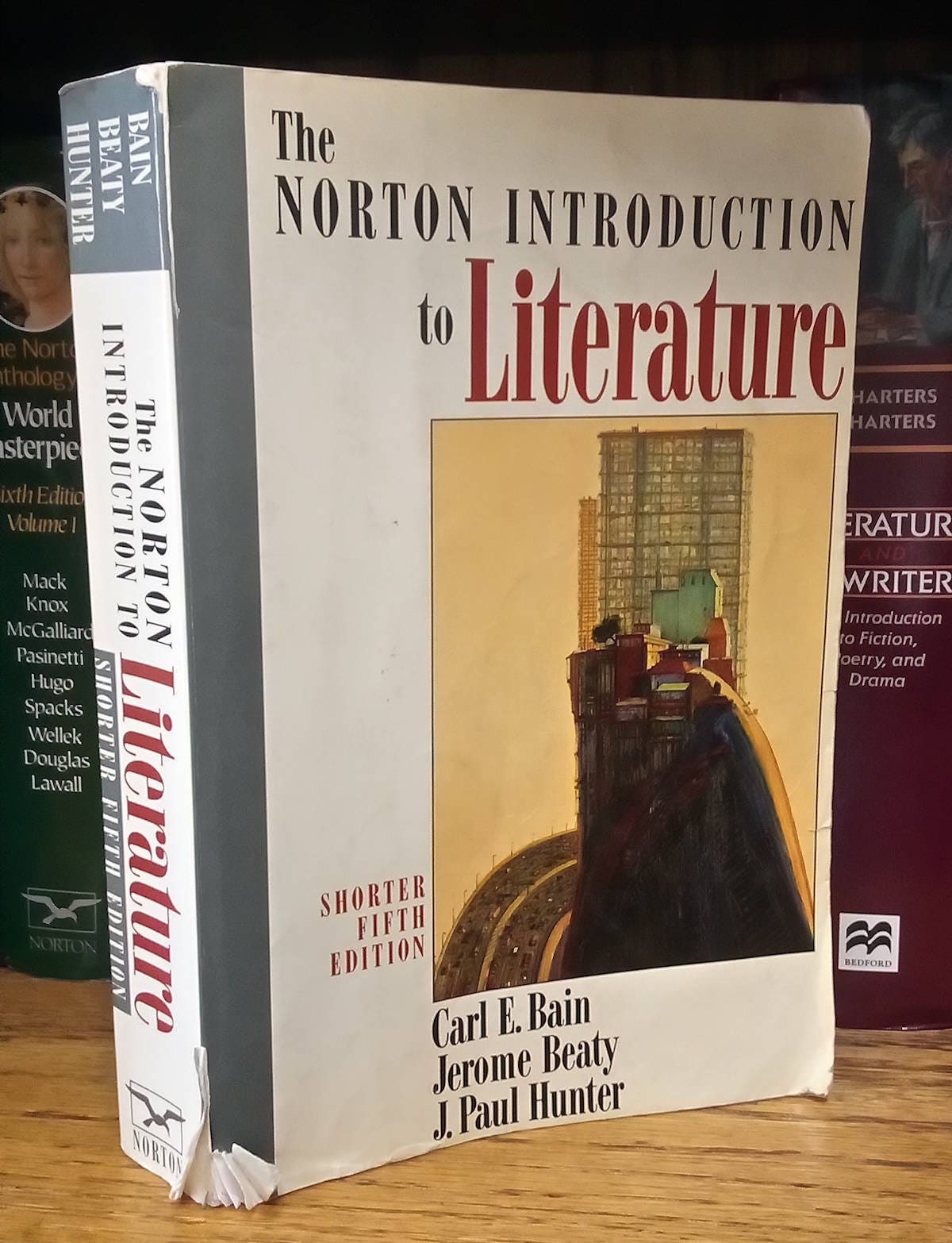
This is of course from Shakespeare’s A Midsummer Night’s Dream. The text here is printed in The Norton Introduction to Literature, Shorter Fifth Edition.
Perhaps not meaninglessly, this passage is the single portion of dialogue that resonates in my mind most loudly and pressingly from multiple viewings of Dead Poets Society. Not Robin Williams shouting “Carpe diem!” but Robert Sean Leonard, as Neil Perry, speaking these lines directly to his disapproving father, who is standing behind the back row during the first and only performance in Neil’s tragically cut-short acting career.
Sometimes Leonard’s soft and vulnerable recitation of these lines comes to mind with no warning and speaks itself in the background at some point during my day. Usually it’s when I’m at home, often when I’m getting dressed or spending a moment in my library/music room. Now that I think of it, this has happened rather frequently over the years. So it’s distinctly strange that these lines from that play would be the first to present themselves in this seven-day experiment, or whatever it is.
More tomorrow, on Day Two.
Warm regards,

The Kindle edition of Writing at the Wellspring is available for preorder. Much of its content was first published here at The Living Dark in a different form. Whether you’ve known my work for years or are just coming across it, this book brings together my thinking about creativity, inner silence, the daemon muse, and the strange, life-shaping currents beneath inspiration. It’s part craft, part philosophy, and part spiritual manifesto.
If this resonates, know that preorders genuinely help a new book reach the readers who might need it. December 15 is the release date for both print and electronic editions.
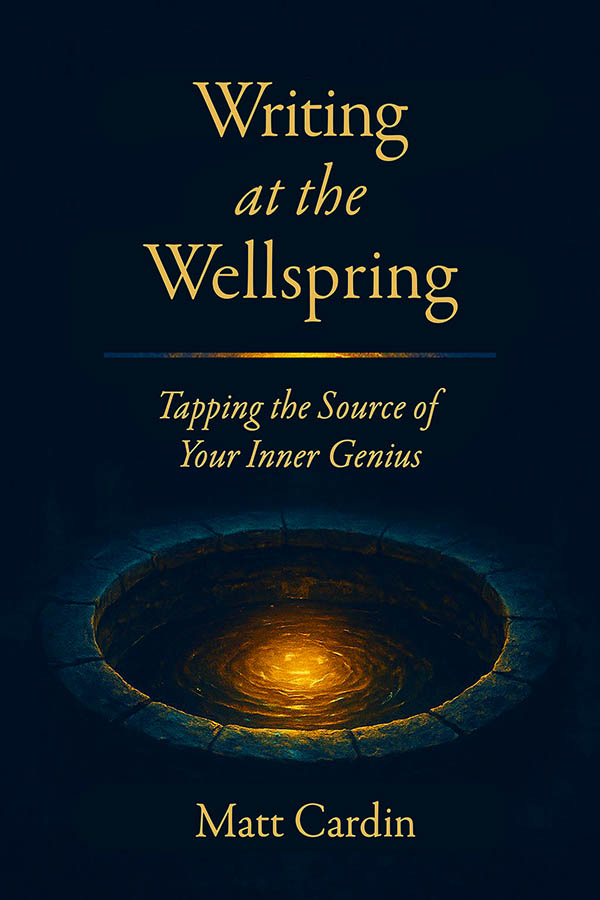
“A guide for writers who welcome the dark and hunger for meaning.
— Joanna Penn“I can’t think of any [other books] that link the creative act so uniquely or persuasively with spirituality.”
— Victoria Nelson“A meditation on the silence and darkness out of which all creative acts emerge....A guide for writers unlike any other.”
— J. F. Martel“Important to any writer ready to see through the self illusion and realize the freedom this brings to any creative work.”
— Katrijn van Oudheusden
This sounds like fun and reminds me of the cut up method used by Burroughs, David Bowie, and the guy who invented it, whose name escapes me. Look forward to reading the end result.
In the M. R..James story "The Ash Tree" two characters use a Bible this way to cull 3 quotes for guidance.