

Dear Living Dark reader,
For an explanation of this series, including what it is, where it’s coming from, and why I’m writing it, see the previous post.
It’s now Day Two of this bibliomantic experiment, and here’s what gave itself to me this morning when I approached the bookshelf in my college office:
CHEEVER: I think it be my duty, sir—Kindly, to Proctor: You’ll not deny it, John. To Danforth: When we come to take his wife, he damned the court and ripped your warrant.
PARRIS: Now you have it!
DANFORTH: He did that, Mr. Hale?
HALE, takes a breath: Aye, he did.
PROCTOR: It were a temper, sir, I knew not what I did.
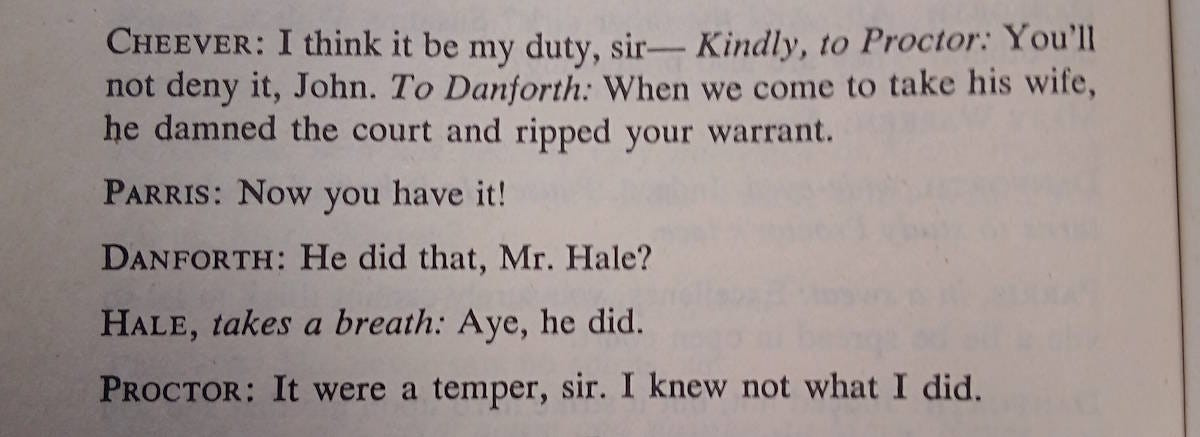
This is from Act Three of Arthur Miller’s The Crucible.
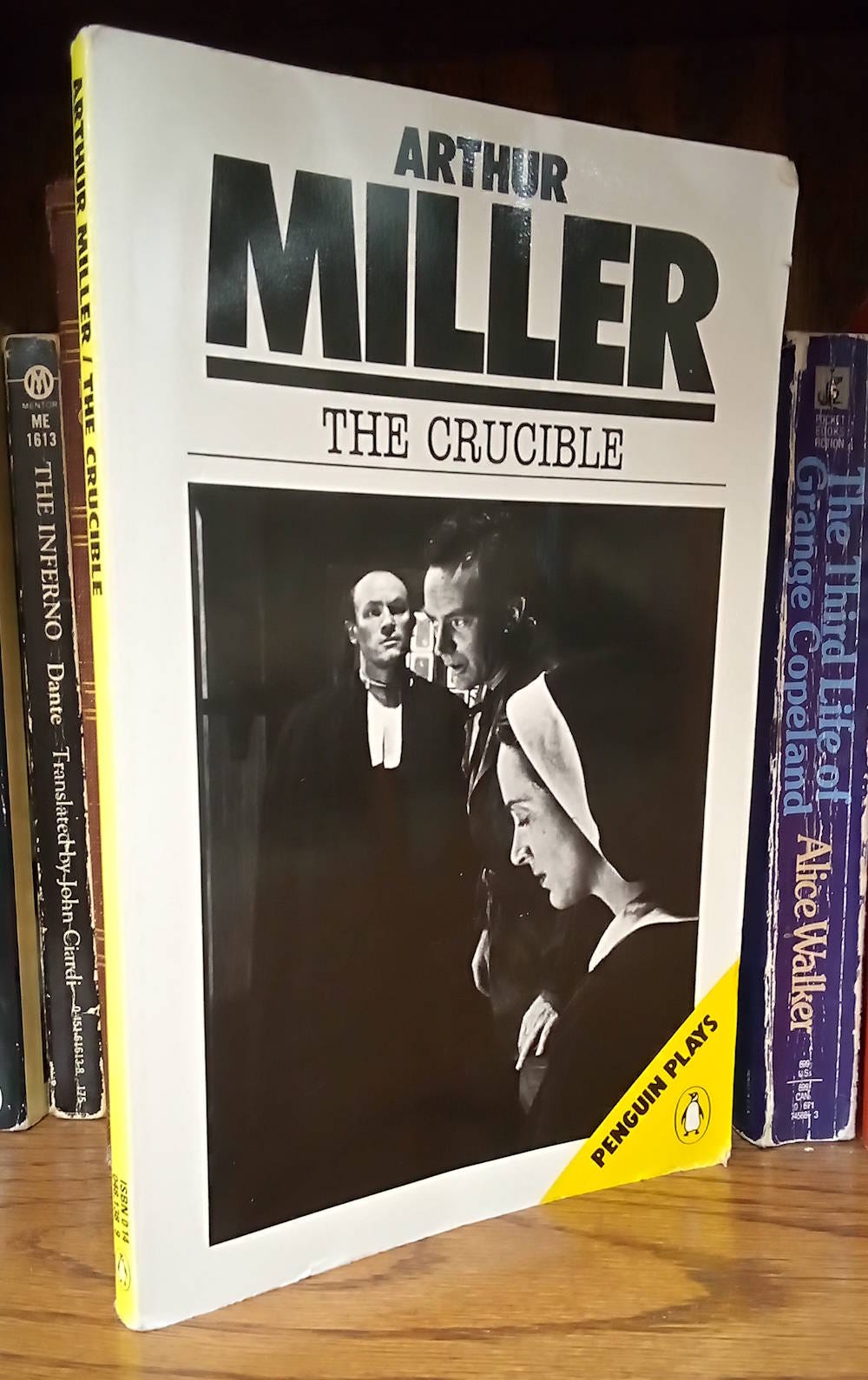
It’s an interesting result for the day’s bookish divination. By way of what I suppose must count as a guilty confession, I’ve never actually read Miller’s play, nor have I seen it performed. Naturally, I’m well aware of it as part of the cultural firmament, and I’m generally familiar with what it’s about. I can rattle off a description like, “It’s a mid-twentieth-century play set during the Salem Witch Trials, which it uses to interrogate the fears and political anxieties of America’s Red Scare during the McCarthy era.” That said, I fear my knowledge may not be too different from what Woody Allen once described in his joke about speed reading: “I took a speed-reading course and read War and Peace in twenty minutes. It involves Russia.”
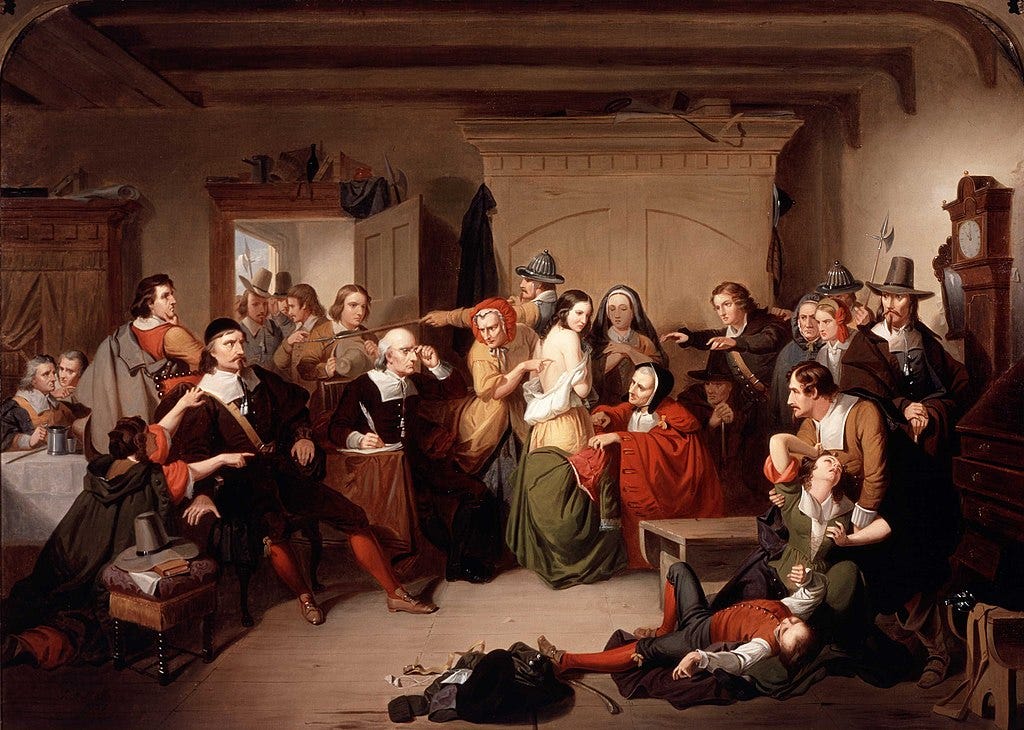
If I search for any obvious touch points in my own life and concerns, I could mention that my sister, who grew up with me in the Missouri Ozarks, has lived in Salem, Massachusetts, for more than two decades. I have visited her there and toured the witch-trial exhibits and all that. I could also mention that the witch trials took place not in modern-day Salem but in nearby Danvers, formerly Salem Village. And I could mention that the Danvers State Hospital—or Danvers Asylum—has been an object of distinct fascination for me for many years. And that the positively sublime Session 9, which I hold to be one of the greatest horror films ever made—and, I’ll just say it, one of the greatest movies, period—was shot entirely on location at the Danvers State Hospital, whose atmosphere soaked itself into the celluloid. And that the movie’s utterly horrifying and convincing presentation—almost an argument—for the reality of a supernatural spirit of violence that sometimes enters people who serve as its unwitting hosts because of a peculiar suitability in their damaged nature (“the weak and the wounded”) is something that surfaces in my thoughts regularly, maybe once every couple of weeks, just like Puck’s lines from A Midsummer Night’s Dream that arrived in yesterday’s bibliomantic delivery.
I could also look into the immediate context of the lines in Miller’s play. It turns out they refer to a moment in Act Two when John Proctor, learning that his wife Elizabeth is being arrested on false charges, erupts in fury at the officers who have come to seize her. Cheever, Parris, and Danforth are now recounting that moment before the court: a husband tearing up the legal warrant that authorizes his wife’s imprisonment. Proctor calls it “a temper,” but the scene in the play makes it clear that this is a flash of righteous rage, an instinctive revolt against an authority he recognizes as corrupt. It’s a turning point, the moment when a character refuses to cooperate with a system that punishes the innocent while calling it virtue, when private conscience begins to resist public madness.
Whether this has any resonance with yesterday’s lines from Shakespeare, or with anything stirring quietly in my life, I’ll leave for now. There are still five days to go in this experiment, and any patterns may show themselves only in retrospect.
By the way, I invite you to join me with your own bookish divinations in the comments. After yesterday’s post, more than one reader told me they find this whole bibliomancy experiment fascinating and that they’ve decided to follow along with their own books. I’d love to hear how it unfolds for you if you choose to join in. Who knows, maybe our collective gleanings and deliveries might form a larger picture.
I’ll see you here for Day Three.
Warm regards,

The Kindle edition of Writing at the Wellspring is available for preorder. Much of its content was first published here at The Living Dark in a different form. Whether you’ve known my work for years or are just coming across it, this book brings together my thinking about creativity, inner silence, the daemon muse, and the strange, life-shaping currents beneath inspiration. It’s part craft, part philosophy, and part spiritual manifesto.
If this resonates, know that preorders genuinely help a new book reach the readers who might need it. December 15 is the release date for both print and electronic editions.
“A guide for writers who welcome the dark and hunger for meaning.
— Joanna Penn“I can’t think of any [other books] that link the creative act so uniquely or persuasively with spirituality.”
— Victoria Nelson“A meditation on the silence and darkness out of which all creative acts emerge....A guide for writers unlike any other.”
— J. F. Martel“Important to any writer ready to see through the self illusion and realize the freedom this brings to any creative work.”
— Katrijn van Oudheusden
Thanks for the invitation to play along. My first quotation will be from Nat Cassidy's novel, When the Wolf Comes Home: on page 182, the main character declares, "You get to be a certain age and they stop calling it scared and start calling it anxiety".
My day 2 is from a Substack page I just read (Into the Deep Woods): It sometimes feels to me that the main problem we have in Western society is a desire for fixity, for the material of our existence to be fully knowable, controllable, subject to the individual or collective will.
I did this this morning, inspired by your post of yesterday. (I've even written about it a bit in a post I haven't published yet--not entirely sure I will) but here is my passage. I chose my shelf of travel books, and this came from a book called CLEAR WATERS RISING about a man's walk across the mountains of Europe from Spain to Istanbul:
"A narrow path climbed steeply over rocks and tree roots, and using Que Chova to drive back the briars, I passed beneath a cliff, or a wall, then scrambled over boulders to the brink of a void. Deafened by the rise and fall of my own breath, I wondered where the castle had gone, then found the path again, cutting unexpectedly along a shelf on the north side of the ridge. The path led to the castle gate."
This feels entirely relevant to what's going on in my own life at the moment, which at times absolutely feels like being lost on the brink of a void and unable to hear anything but my own breath. Heartening to know that if I keep beating back the briars, the path will reappear and take me to my intended destination.