

“Our Imperfect Fossil Record” — A Week of Bibliomancy, Day 6
A seven-day divinatory reading experiment
Dear Living Dark reader,
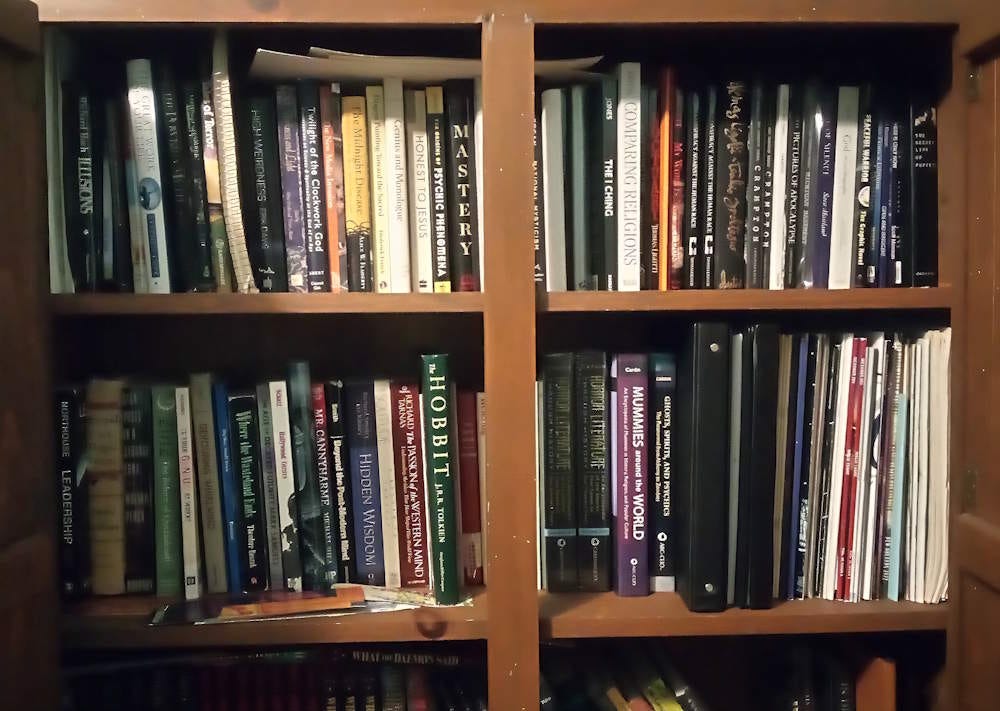
Today’s entry is different from the previous ones. When I started this experiment five days ago, I forgot that today I wouldn’t be in my office at the college, which means my college bookshelf wouldn’t be available. So I’ve simply gone with the flow and used one of my bookcases at home as the source of today’s bibliomantic divination. It’s actually an old armoire I’ve used for years to hold some of my books. As you can see, I’m not overly particular about neatness.
Here’s the gleaning that presented itself today:
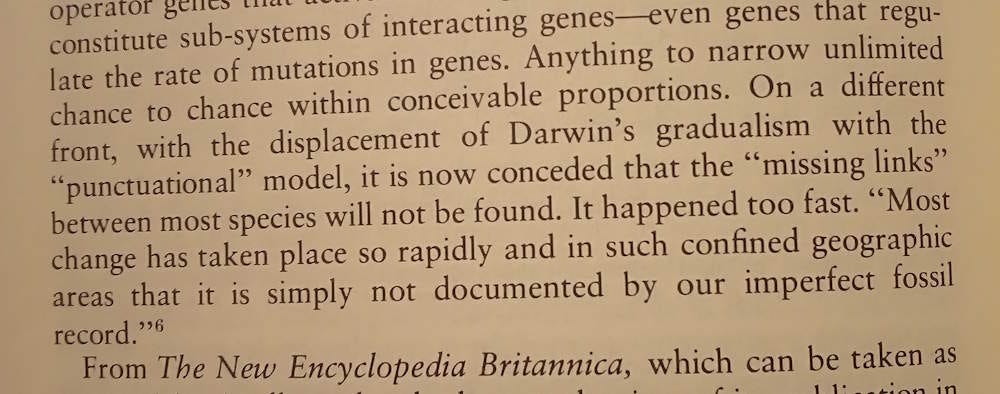
On a different front, with the displacement of Darwin’s gradualism with the “punctuational” model, it is now conceded that the “missing links” between most species will not be found. It happened too fast. “Most change has taken place so rapidly and in such confined geographic areas that it is simply not documented by our imperfect fossil record.”
The book is 1982’s Beyond the Post-Modern Mind by Huston Smith.
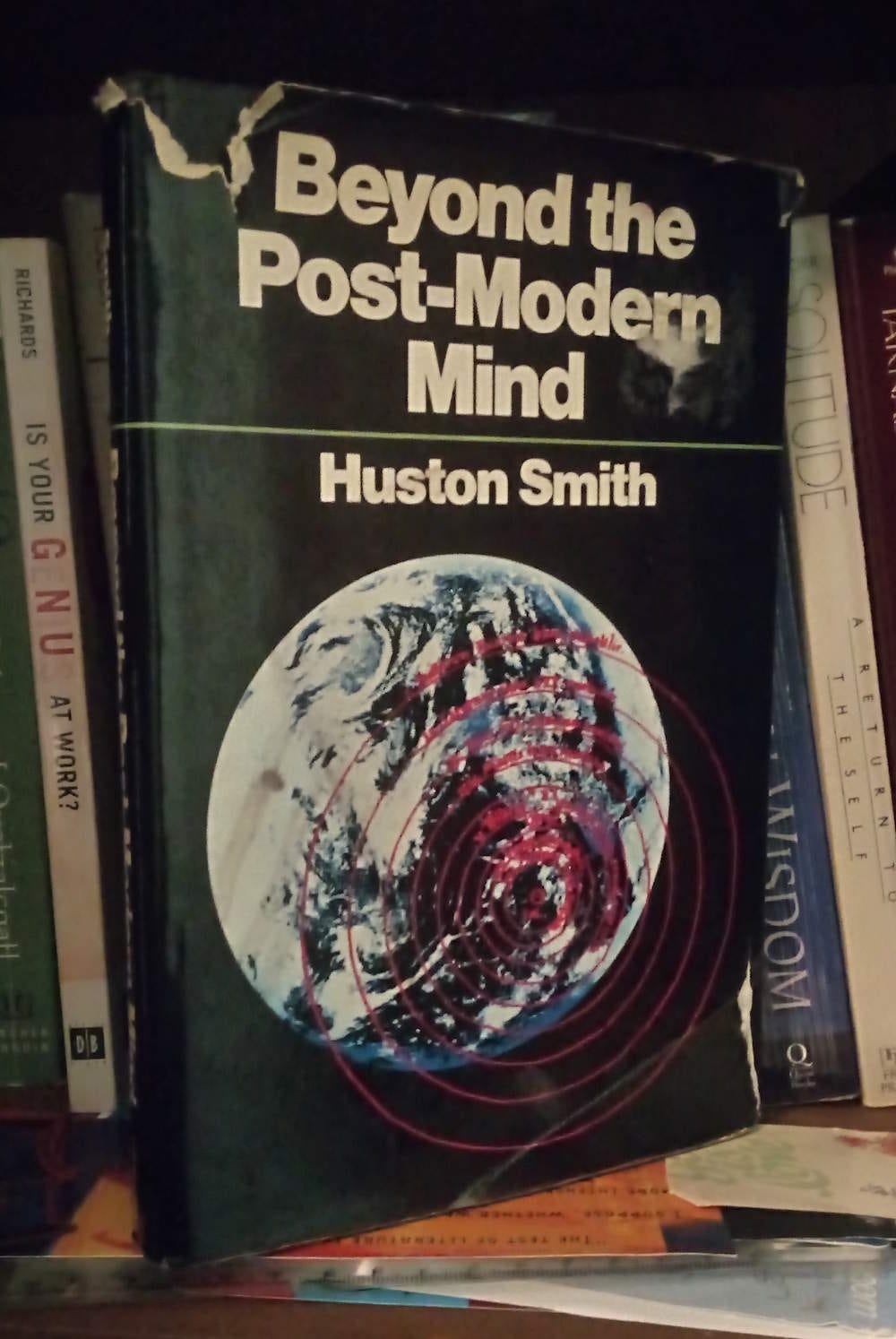
I could have much to say about this passage if time permitted, but today it simply doesn’t, as work responsibilities have occupied me completely from start to finish. Why this particular passage, from this particular book? Beyond the Post-Modern Mind was a pivotal book in my philosophical, intellectual, and spiritual development. It introduced me to Smith and his work at a highly fertile time in my life, during my early-mid twenties, when I was working in video production in the music shows in Branson, Missouri, and caught up in the haze of early adult family life and career matters while also suffering from the sleep paralysis attacks that I have written and said so much about.
I stumbled across the book in the outlet bookstore in Branson’s now departed Red Roof Mall. I read the book in huge, exhilarated gulps while sitting in my car in the parking lot of the Grand Palace music theater between shows by the likes of Glen Campbell, Louise Mandrell, Barbara Mandrell, and Kenny Rogers. I also reread huge portions of it while sitting in the bed of my pickup truck outside Glen’s theater when he left the Palace and opened his own venue.
Smith spoke directly to my philosophical longing and helped to set the tone of my thinking about the relationship between science, religion, and spirituality. He also introduced me to the perennial tradition with its multi-layered ontology and cosmology. His influence on my philosophical formation and later outlook was profound. You can see some of it in my essay on Mary Shelley’s Frankenstein as a parable of the West’s failed quest for enlightenment—now collected in What the Daemon Said—where I quote Smith extensively and draw on his analysis of how scientific materialism rules out transcendence in principle and leads directly to a worldview of hollow alienation. (The paper originally appeared more than 20 years ago in the journal Penny Dreadful.)
So why would these particular words from Smith’s book offer themselves up today, especially as part of a series of previous gleanings that would seem to have little or nothing to do with them? The words themselves are part of Chapter 9, titled “Checkpoints,” in which Smith considers various fault lines that he believed were emerging in the scientistic consensus. In this specific passage, he is critically considering the theory of evolution and the permutations it has gone through, including the rise of a new model of rapid evolutionary change in punctuated bursts that supplanted the former Darwinian model of continuous gradual change.
If I’m seeking some kind of thematic touchpoint with the previous day’s readings, I suppose I can hang it on the fact that this scientific story is indeed a story, a narration, a relation. This is supported by Smith’s words two pages earlier: “Neo-Darwinism is not a description of life’s journey on this planet; it is a theory that purports to explain that journey.” In other words, it’s a story, a narrative, that the dominant Western culture has told (related) to itself. Two pages after today’s passage, he contrasts it with the alternative story told by Creationists. “Thinking it important to believe that earth is only a few thousand years old,” he writes, “their alternative scenario for life’s ascent is mistaken, but in challenging neo-Darwinism’s unsuccessful mechanistic explanation of that ascent, they are performing a public service.” So once again, we’re back to competing accounts—competing relations—of the same events. Only this time the subject at hand is not witchcraft, courtrooms, intergenerational grievance, or dreams, but the origin and development of life itself.
But as I said, I’m pressed for time today, and though there are deeper layers to intuit, this is all I have time to uncover at the moment. Perhaps I’ll be able to draw more from it tomorrow.
As always, I look forward to seeing what you’ve gleaned in your own readings/divinations for this sixth day.
Warm regards,

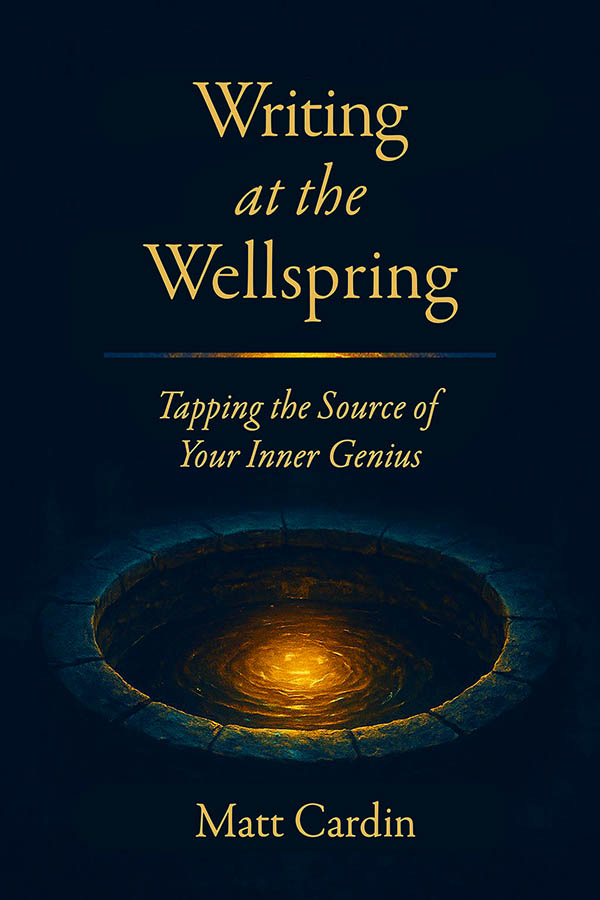
A free online launch party for Writing at the Wellspring
Weirdosphere, the online learning community, will be hosting a free celebratory launch party for my new book Writing at the Wellspring on Sunday, December 14, at 3 p.m. EST, and all of you are cordially invited. I’ll read a short selection from the book, and then we’ll open things up for conversation on the creative daemon, writing as spiritual practice, the challenge of silence, and the path of living and writing into the dark.
The launch party is free, and Weirdosphere has created a special event space for it. To participate—and to show support for the book launch—simply follow the link below. You’ll be prompted to sign up for Weirdosphere and then register for the event:
This will be a casual gathering, so feel free to pop in and out as you wish. A recording of the event will remain available inside the event space for all registrants.
And remember: Writing at the Wellspring is now available for preorder in its Kindle edition, with both Kindle and print editions arriving on December 15.
“[An] intimate journey into the mystery of creativity and spirit… Cardin weaves practical methods, personal stories, literary references, and mystical insights into a lyrical meditation on what it means to create from the depths of the soul… both deeply personal and universally resonant.” — BookLife review (Publishers Weekly)
“A guide for writers who welcome the dark and hunger for meaning.
— Joanna Penn“I can’t think of any [other books] that link the creative act so uniquely or persuasively with spirituality.”
— Victoria Nelson“A meditation on the silence and darkness out of which all creative acts emerge....A guide for writers unlike any other.”
— J. F. Martel“Important to any writer ready to see through the self illusion and realize the freedom this brings to any creative work.”
— Katrijn van Oudheusden
Day 6: “Just look at that red horse, Steve!” Pitch’s voice was guttural, his words hardly distinguishable. “He’s been through this before. He’s not scared a bit. He’s fought his way to the top and that black stallion is going to have to kill him to take his title away. Look, Steve! You never saw such confidence as that red devil has!”
The Island Stallion by Walter Farley pg. 106
The weathered cover of this book that belonged to my mom as a child, who then gave it to me to read at about age 8, has my childish scribble of a name written in the front cover. Mom introduced me to the "Black Stallion" novels and I loved them. The dedication reads "Dedicated to all boys and girls who love horses but never had one of their own." That was me.
I think it is interesting that of all the books on my office shelf-- that in this exercise I have pulled the two books that were owned by family members that have passed in the last couple of years. I'm not sure where I am when considering if we continue on in some way after death, and if those who have moved on are aware of us here, but sometimes it sure feels like it.
As for the passage itself and how it relates to the greater message of the journey/adventure we are all on in this old life, well, this one hits. Fighting one's way through the vicissitudes and difficulties of life develops a metal in the spine that is not easily taken away. In my experience you must become who you really are or die fighting. I suppose that sounds dramatic, but so is life.
Matt - in my previous comment I apologized for not being able to participate in the bibliography divination, due to my situation on the home front - but perhaps your essays are still so relevant to me due to a practice I'm undertaking with my Tarot. I've been using the throw of images to commune with my partner of 50 years who passed away in 2018. I foolishly mentioned this to a friend who thought I'd gone over the edge, so I've kept quiet about this since. A deep and resonant relationship which oriented most of my adult life had been torn away, and I resorted to the Tarot trusting that somehow my partner was now a component of the so-called random pull of images. When you've been so much a part of another's life, you know how they speak, how they form idea, how they express humour or irritation. The cards appear, following the shuffle and random selection of 10 cards, in his unique voice and character. I speak with him, feel him within me, and pull the cards....and he answers me. I don't feel he is a "ghost" floating around...rather, what he was is now part and parcel of limitless Universe relating and responding to another cell in its body - Me. While that Universe presents itself particularized in the presence of a loved one, it is not confined within nor limited by that particular expression. Perhaps something so powerful a loss...something that felt worse than death, opened me to allow that inter-communication ? Perhaps a profound degree of Will - a deep investment in our questions - is necessary to open the barrier of pseudo rational skepticism before Divination can arise?