

Dear Living Dark reader,
This year, alongside essays and book notes, I’ll be posting occasional batches of short thoughts and perspectives, some in response to things I’ve been reading, others as stand-alone reflections. Essentially, these will be curated collections of thoughts that have crossed my mind and interactions I’ve had with books, articles, essays, and other material. They’ll also function, at times, as informal menus of suggested reading, in case you’re interested.
These posts won’t have a single through line. I won’t be grouping material for thematic coherence, or else I’ll do it only lightly. Topics within each post will be all over the map, a kind of kaleidoscopic grab bag of ruminations.
This is the first such post. For no particular reason, I’ll gravitate toward publishing these posts on Tuesdays. All bolded text below represents my own emphases. I’m always interested to hear your thoughts, so comments are welcome. And please feel free to share this with anyone you think might find it interesting or valuable.
Warm regards,

Is poetry worth it?
Is poetry, and by extension other forms of art and creativity, “worth it” in a world of more practical concerns and troubles? It’s a question that comes up for many of us who are drawn to reading, writing, and the arts. The Irish poet Maurice Riordan provides a nuanced answer to it in an interesting interview for Literary Hub:
I suspect most people who write poetry, myself included, have squandered the chance to do something more worthwhile for the world. I do have faith in the creative imagination, overall, from the cave paintings to rap, as well as its role in mathematics and science, and including, too, the religious and moral imagination. Human history would be only diabolic without it. And with it? Perhaps not good enough—who knows yet.
—Peter Mishler, “Maurice Riordan on Writing Rituals, the Creative Imagination, and His Journey as a Poet,” Literary Hub, December 12, 2025
The weird fictional flavor of nonduality
In Nisargadatta Maharaj’s last book of recorded talks, 1994’s Consciousness and the Absolute, the very first page contains a statement by him to a questioner that illustrates and conveys the resonance I have always felt between nondual utterances of the purest sort and the core mood and worldview of weird fiction as exemplified by the likes of, say, Ligotti:
You are an illusion, Maya, an imagination. It is only because I know that I’m unreal that I know you also are unreal. It is not like this: Because I am real you are unreal. It is like this: Because I am unreal, everything is unreal.
—Nisargadatta, in Jean Dunn, ed., Consciousness and the Absolute: The Final Talks of Sri Nisargadatta Maharaj (The Acorn Press, 1994), 1–2.
You can find the book online.
Why miracles don’t matter
First: Miracles, as in phenomena that appear to break or go beyond the rules and possibilities of conventional reality, are real.
Second: When you recognize reality’s nondual nature, miracles are utterly beside the point.
Some elucidation:
NISARGADATTA MAHARAJ: There is no end to the miracles that can happen in the world, but they are still of the manifest. There have been many powerful minds and powerful beings, who, by their penance or strength of mind, have acquired powers and performed miracles. What has happened to them?
QUESTIONER: The same thing that happens to everyone. [That is, they died.]
N: If they have had the experience of their true Self, such people would not be striving to acquire powers…I am not concerned with any miracles except the three within myself. The first is that I am able to see the world; the second is that the world is contained in that tiny spot of consciousness which I am; the third is that from that no-being state this beingness has come. Give thought to these miracles.
—Nisargadatta Maharaj, Seeds of Consciousness, ed. Jean Dunn (The Acorn Press, 1982), 179, 192.
The mysterious source of ideas, poetic and otherwise
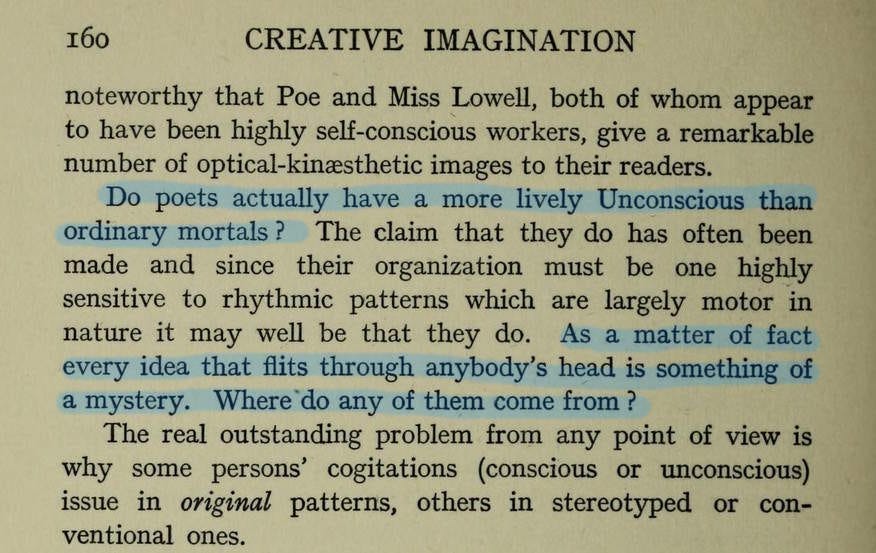
Here’s psychologist June Downey on the inner lives of poets and the rest of us. I love her easy emphasis on the fact that it isn’t just the workings of creative genius that are mysterious. Everything about our mental lives, and by extension our inner lives as a whole, is steeped in the unknown.
Do poets actually have a more lively Unconscious than ordinary mortals? The claim that they do has often been made. . . . As a matter of fact every idea that flits through anybody’s head is something of a mystery. Where do any of them come from?
—June Downey, Creative Imagination: Studies in the Psychology of Literature (London: Kegan Paul, Trench, Trubner; New York: Harcourt, Brace, 1929), 160.
Art and mysticism
In An Anatomy of Inspiration—a great, classic, necessary book—Rosamund Harding offers the following insight on the resonance between art and mysticism:
[The artist] is he who catches and fixes those fleeting lights, those transient intuitions that we see for a moment out of the corner of the mind’s eye…
It is this submission to a higher power; the nature of things; that provides the analogy between creative art and mysticism. The artist is, so speak, given his themes and, once given, he must follow their unfolding. While he transcribes it is dictated to him: it is not the deliberate outcome of his will; and it is this that has given rise to the thought that creation is the result of inspiration—a breathing in by some exterior spirit.
Since the operations of life are continually flowing on there is always something new for the artist. Hence a great work of artistic genius is one which arrests attention. The intensity of the artist’s creative mood—its special character—is reflected and casts its spell on the beholder, reader or listener.
—Rosamond E. M. Harding, An Anatomy of Inspiration, and An Essay on the Creative Mood, 3rd ed. (Cambridge: W. Heffer & Sons, 1948), 144.
An early Wellspring review
An early (prepublication) review of Writing at the Wellspring at Goodreads features a closing line that, if I hadn’t written the book myself, would be enough to draw me to it:
“If Colin Wilson and Krishnamurti and ST Joshi had written a tome on the essentials of creativity, it would be something like this.”
Yes, this helpfully clarifies my vibe.
AI marketing and the indignities of death
The onslaught of fake book marketing come-ons gets weirder: Some of you know that I wrote the introduction to Mark Samuels’s final book, the absolutely wonderful Charnel Glamour. (You can read the whole thing right here.) In December I received an email through my website contact form that began with this:
Hello Mark. My name is Ruth G. Bryant, Marketing Manager at Bestseller Bridge, and we’ve completed a seasonal visibility review of Charnel Glamour. With the holiday season bringing readers more time to explore immersive fiction, your collection is positioned strongly for fans of literary and weird horror seeking richly atmospheric, unsettling stories.
It went on to do a version of the usual tap dance with a concluding come-on for a conversation with “Ruth” about increasing the book’s visibility among readers. Of course I’ll just brush this one off like I’ve done with the dozens of previous versions of the same AI-written shtick that I’ve received over the past few months. However, all the other ones were addressed as if to me. The fact that this one confused me with Mark and tried to do its con job with the last book he ever wrote is pretty annoying. I know it’s just the result of an impersonal shotgun approach, plus the fact that my name appears with Mark’s on the Amazon listing and elsewhere. But it still pisses me off a bit. Maybe this reaction is abetted by the fact that the email arrived eight days after the second anniversary of Mark’s sudden death, which occurred less than 24 hours after I had sent him the completed introduction, which I later heard he had been delighted with.
I also wrote the introduction to the late Joseph S. Pulver’s Portraits of Ruin. I wonder if I’ll end up receiving book marketing spam addressed to Joe beyond the grave as well.
The sound of Claude
It’s apparent that many writers, at least at Substack, have begun using Claude to write pretty much everything they post online. The thing is, I can tell. So can anyone who reads closely and has learned to recognize Claude’s typical voice and style. It’s garishly apparent. And I’m seeing it absolutely everywhere. What’s especially annoying or icky about it is Claude’s signature rhetorical pose of pointed authenticity, consisting of short, punchy sentences and sentence fragments infused with a tone of “come on, let’s just be honest here”—an artifact of what I’m assuming is rhetorical training and tuning on a lot contemporary online writing. So, in other words, the overarching, unstated ethos is “Let’s just be frank, honest, plainspoken, and bravely to the point—while outsourcing our writing and our voice to an AI.” Irony, anyone?
The ordinary is extraordinary
I love this. A lot:
The extraordinary turns out to be nothing other than the ordinary seen without the assumption that something essential is missing.
—Freyja Theaker, “Let’s Flip the Script,” Naturally Being Nondual, December 9, 2025
Blowing up the house of you
This Substack Note from Luka Bönisch is dynamite. Almost literally. It might blow up the house of “you.” Or at least explain a demolition that could already be underway.
The world is within me
Who am “I”? And what is “the world”? Can we improve either of them? And does a true spiritual awakening hamstring our ability to carry out life’s normal duties? Further: Are the questions themselves perhaps misconceived? The following question/answer session goes deep and runs counter to how most of us understand things at the most basic level. That’s one reason why it’s worth taking in.
NISARGADATTA: The world is within me, I am not within the world…
QUESTIONER: Since this manifestation is myself can I bring about certain improvements in it?
M: When you cling to the body-mind you become separate from the manifest world and you see different entities. In that state you will have all kinds of desires to improve yourself or somebody else. The next state is “I Amness,” in which every action is myself, every manifest thing is myself. In that state there is no question of improving; you are just manifestation, “I am everything.” Next is the Unborn state, where there is no beingness to understand “I Am.” That is the highest state…
I am trying to speak of the most intimate secrets. Just as the dream world [in sleep], uncalled, has appeared and you observe it, similarly this world, uncalled for, has appeared and you are compelled to observe it. Just observe…
Q: Can I carry out normal household duties?
M: Carry them out with all enthusiasm, but understand what I have told you. If you really understand this, remember it and ponder it; no special meditation is needed…
Meditate on that principle by which you know you are and the world is. That is the very source of this manifest world.
—Nisargadatta Maharaj, Seeds of Consciousness, ed. Jean Dunn (The Acorn Press, 1982), 152–153.
On living in the world, and vice versa
A common question when someone hears or glimpses the nondual perspective is, “Then how should I live in the world?”
The answer, of course, is that the question is misconceived. You don’t live in the world. You never have. Rather, the world lives in you.
The ultimate awakening
Here’s Wei Wu Wei, one of the most direct and uncompromising nondual writers of the past century, using impeccable logic to annihilate—and then redeem—you and me and the entire universe. It requires us to slow down, read very closely, and appreciate the chain of reasoning very carefully. Those who have lived their way into a clear grasp of the subject/object divide may be find this especially impactful:
Objects . . . are only a surmise, for they have no demonstrable existence apart from the subject that cognises them.
Since that subject itself is not sensorially cognisable except as an object, subject also is only a surmise.
Since the factual existence of neither subject nor object can be demonstrated, existence is no more than a conceptual assumption, which, metaphysically, is inacceptable.
There is, therefore, no valid evidence for the existence of a world external to the consciousness of sentient beings, which external world is therefore seen to be nothing but the cognisers of it, that is—sentient being themselves.
But there can be no factual evidence for the existence of sentient beings, either as subject or as object, who therefore are merely a conceptual assumption on the part of the consciousness in which they are cognised.
It follows that “consciousness” also can only be a conceptual assumption without demonstrable existence. . . .
[C]onsciousness may be regarded as the manifested aspect of the unmanifested or non-manifestation, which is the nearest it seems possible to go towards expressing in a concept that which by definition is inconceivable. . . .
All that we can say about this which we are, which to us must be objectified as “it” in order that we may speak of it at all, is to regard “it” as the noumenon of phenomena, but, since neither of these exists objectively, phenomenally regarded it may be understood as the ultimate absence from which all presence comes to appear.
But consciousness or “Mind,” does not “project” the phenomenal universe: “it” IS the phenomenal universe which is manifested as itself. . . .
This-Which-Is, then, which cannot be subject or object, which cannot be named or thought, and the realisation of which is the ultimate awakening, can only be indicated in such a phrase as [this]: “I am not, but the apparent universe is my Self.”
—Wei Wu Wei, “‘I Am Not, but the Universe Is My Self’ (Shit-t’ou, 700-790): Logical Analysis of This Intuition,” The Mountain Path 1, no. 1 (1964): 44.
The core teaching
Here’s Jean Dunn, who spent years as a student of Nisargadatta Maharaj, explaining his core teaching in her introduction to Seeds of Consciousness, one of the books she created from transcripts of his talks:
The entire universe exists only in Consciousness. . . . In Consciousness the world appears and disappears. All there is, is Me; all there is, is Mine; before all beginnings, after all endings, I AM. Whatever happens, I must be there to witness it. Therefore, it is not that the world does not exist. The world is an appearance in consciousness which is the totality of the known in the immensity of the unknown. What begins and ends is mere appearance. The World can be said to APPEAR but not to BE.
Maharaj tells us that whenever every single individual dreams, he has the actual experience of the world being created in consciousness. When a person is not fully awake, and consciousness merely stirs, he dreams, and in his dream, in that tiny spot of consciousness, in a split second, is created an entire world exactly similar to the world outside. . . . But once he wakes up, the entire dream world merges in the consciousness in which it was created. In the waking state, says Maharaj, the world emerges because of ignorance (Maya) and takes you into a waking dream state. Both sleep and waking are misnomers because you are only dreaming; you dream that you are awake, you dream that you are asleep. . . . The main point to grasp is that you have projected onto yourself a world of your own imagination, based on memories, desires, and fears, and that you have imprisoned yourself in it. Realize that, break the spell, and BE FREE.
—Jean Dunn, explaining the core teaching of Nisargadatta Maharaj in her introduction to Seeds of Consciousness, ed. Jean Dunn (The Acorn Press, 1982), 12–13.
If you enjoyed this post, please consider sharing it with a friend. I’d also love to hear your thoughts and comments.
Support This Work
If you want to materially support The Living Dark, you can make a one-time donation or choose a recurring monthly donation. I spend a lot of time tending this project, so I sincerely thank you for even considering it. All posts will always remain free.
One-time donation:
Recurring donation:
Published in December:

“[An] intimate journey into the mystery of creativity and spirit… Cardin weaves practical methods, personal stories, literary references, and mystical insights into a lyrical meditation on what it means to create from the depths of the soul… both deeply personal and universally resonant.”
— BookLife review (Publishers Weekly)“A guide for writers who welcome the dark and hunger for meaning.
— Joanna Penn“I can’t think of any [other books] that link the creative act so uniquely or persuasively with spirituality.”
— Victoria Nelson“A meditation on the silence and darkness out of which all creative acts emerge....A guide for writers unlike any other.”
— J. F. Martel“Important to any writer ready to see through the self illusion and realize the freedom this brings to any creative work.”
— Katrijn van Oudheusden
Available from all the major stores (Amazon, Bookshop, Barnes & Noble, etc.) in both paperback and electronic editions:
This is great, Matt. It's going to take a few days to go through. The authors so familiar, yet the quotes that stood out for you, with brief commentary at times, bringing a fresh perspective: As if reading again and yet for the very first time. Thank you!
Yesterday my browser would not open this post, but today I read most of this and will be back to finish. I hope you will continue this smorgasbord of quotes and thoughts.