

Magic, Meaning, and the Fabric of the Real
Thoughts, quotations, and fragments (2)
Dear Living Dark reader,
This is the second installment in a series of posts that I’m classifying under the rubric of “thoughts, quotations, and fragments.” As I explained in the first installment last month, each post represents a batch of assorted excerpts, perspectives, and commentary, some of it in response to things I’ve been reading, and other parts serving as stand-alone reflections. Think of these posts, if you wish, as curated collections of thoughts that have crossed my mind, cross-fertilized by interactions that I’ve had with books, articles, essays, and other material—including conversations with people. At times they may also serve as informal menus of suggested reading.
Here are two preliminary items ahead of the main substance of this edition:
FIRST, I’m semi-surprised to see that Amazon’s AI-generated description of Writing at the Wellspring, which accompanies the book in the search listings, is actually quite good:
A spiritual guide exploring creativity as a path to awakening, teaching writers and artists how to tap into their inner genius through silence, presence, and nondual awareness.
Beyond Amazon, the book’s distribution has now been fully enacted, so it’s available not just at the likes of Amazon and Barnes & Noble but at Bookshop.org, Books-a-Million, and pretty much everywhere.
SECOND, I recently sat down with Brad Kelly on his Method and Madness podcast to talk about the core premise behind Writing at the Wellspring: that the creative life isn’t primarily a matter of “technique,” but of an inner relationship with the daimon/muse, the inner force that feels like you and not-you at the same time, the thing you can either cooperate with or fight against until it burns you up.
We got into Jung’s line about the creative person being “captive and driven,” the Gospel of Thomas’s warning about what happens when we don’t bring forth what’s within us, and the flow state as something like full alignment with the daemon muse. We also talked about the danger of letting the left-brain “emissary” seize the throne, especially in the modern era, when it’s so easy to measure creative “success” by numbers (money, engagement, impressions) instead of by what the work itself asks of us.
Along the way we wandered into bibliomancy, tarot-adjacent meaning-making, synchronicity, cosmic horror as spiritual territory, and the deeper question hiding behind every “random” sign: what does anything mean? And we also touched on silence, creative droughts, the desire to stop entirely, and why “breaking the spell” may sometimes mean giving yourself permission to sit perfectly still and wait.
At the end, I shared a few under-discussed books that have shaped me: Victoria Nelson’s On Writer’s Block, Theodore Roszak’s Where the Wasteland Ends (and also his wonderful novel Flicker), and Dorothea Brande’s Becoming a Writer.
You can listen to the episode here:

LISTEN: Matt Cardin on Writing at the Wellspring
And now, having said all that, it’s on to today’s gallery of assorted items.
The mysticism of Christmas morning
I know we’re now several weeks past Christmas, but for what it’s worth, here’s an important Christmas message that is actually meant for other times, as indicated by the words themselves:
We really should awake each day as if it were Christmas morning, as if the dawn were bringing us—in G.K. Chesterton’s phrase—“absurd good news.”
That’s a summary of the core message or outlook of Colin Wilson, the late British philosopher and author, from Michael Dirda’s review in The Washington Post of a biography of Wilson by Gary Lachman. (See “UFOs, Alien Abductions, and the Occult: To One Man, the Building Blocks of Scholarship,” August 31, 2016).
Wilson famously pointed to Christmas with its magical mood, which we feel most strongly in childhood, as an opportunity for recognizing something about the frankly amazing, mind-blowing nature of reality itself. In his novel The Philosopher’s Stone, he wrote:
Childhood conditions us to relax and expand at Christmas, to forget petty worries and irritations and think in terms of universal peace. And so Christmas is the nearest to mystical experience that most human beings ever approach.
In his introduction to The Ultimate Colin Wilson: Writings on Mysticism, Consciousness, and Existentialism, Wilson pointed out that Chesterton’s sense of “absurd good news” is frequently supplanted in our experience by something darker:
The feeling of absurd good news is often contradicted by its opposite—what might be called “absurd bad news”—a feeling that we are helpless victims of forces far stronger than we are. In these moods, it seems that all our “values” are illusions created by the body.
And again, he drew a connection to Christmas, observing that this holiday actually serves as a focal point for both outlooks, the one of a heavy emptiness and despair and the other of a buoyant, magical enchantment, with each outlook seeming plausible whenever it has a hold of us:
For me, the problem first presented itself at Christmas-time as a child. That marvellous feeling of richness and excitement made it obvious that life is not difficult and boring and repetitive. Then came the new year and return to school, and it was like waking up from a pleasant dream in an icy bedroom. The glow of Christmas seemed an illusion. Yet the moment the moods of happiness and freedom came back—on a day-trip to the seaside or picking blackberries on an autumn afternoon—it was quite plain they were not some kind of delusion or wishful thinking. It was again self-evident that the world was a far bigger and more exciting place than we normally give it credit for.
Elsewhere, in his book Beyond the Occult, he wrote that, for a child on Christmas Day, “everything combines to make life seem wonderful.’‘ He said he remembered from his own childhood that, at Christmastime, he had the sense
that the world is self-evidently wonderful and exciting, and that no problem is too great for human will and persistence. There was a feeling that if only I could maintain this vision, I would never experience any serious problems for the rest of my life.
However, as noted, we generally don’t maintain that consciousness. Instead, most of us go through life wearing a set of philosophical blinders that lead us to mistake the world as a fundamentally dreary place. But that, said Wilson, is a problem with us, not with reality at large. If we saw things as they truly are, we would always feel the magical Christmas glow we remember from childhood, not finding it limited to a single time of year.
Right now, with Christmas nearly two months in the rear view mirror—and with the world continuing to weird out in early 2026 to a degree that would have been unthinkable just a few years ago—this is all worth remembering.
The cosmic horror of Christmas
Christmas, of course, isn’t always entirely cozy. Case in point: If you’ve not encountered Ryan D. Hurd’s writing on the cultural traditions that we’ve collectively built around mythic-dreaming consciousness, his essay from last December titled “The Chimney Portal” is a great entryway into it. Its theme, as named in its subtitle, is “supernatural agents and cosmic coziness on Christmas Eve.” And as if that weren’t enough to endear it to your (let alone my) attention, any piece of writing that contains the phrase ‘‘a nondual Santa, transcending awe and horror” automatically receives my endorsement.
Here’s a key passage to whet your appetite:
Isn’t that pretty much the deal with coziness and the winter vibe in general? It’s an apotropaic effect where we indulge in the contrast of being warm, safe and secure against a backdrop of the cold and unprotected. Coziness itself dabbles in cosmic horror, with warm tea and cookies in hand.
MORE: Ryan D. Hurd, “The Chimney Portal,” Archaeology of Consciousness, December 19, 2025
The ontology of Santa Claus
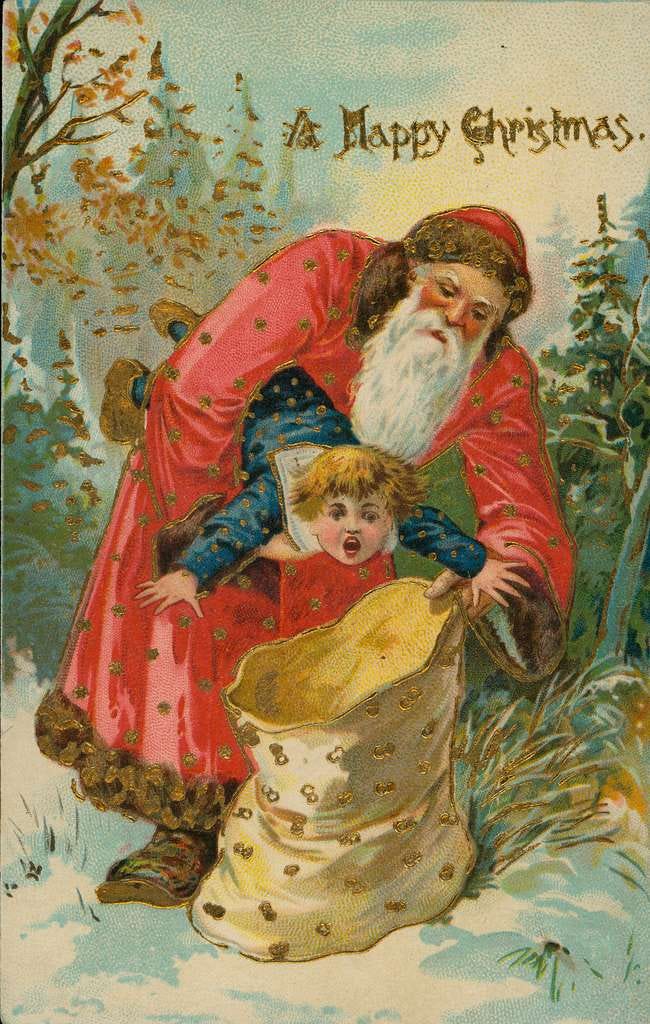
And speaking of Christmas horror, an essay by James Taylor Foreman from late December lays out an ontology of Santa Claus that applies point-for-point to that avatar of high-quality mythic-cinematic horror, Candyman. I mean this without irony or any intent to sully the piece’s excellent insight.
See for yourself:
[W]e all fully participate in Santa’s yearly flight, buying toys and setting up the tree and stockings, and everything else I don’t need to list. In this, we embody the spirit of his elves, sometimes even against our will or own best interest. Collectively, we’re all totally possessed by his animating spirit, and we couldn’t stop it if we tried.
It’s not wrong to participate in that spirit for the delight of our children. What is wrong is sitting them down to tell them it’s all a conspiratorial lie. That is itself a vicious lie. He’s real—the magic is just subtler than we can get at in ordinary speech.
Here I feel like I run into a brick wall, because we are all at least somewhat materialist in our outlook. There is just a tic in the modern mind that wants to be like, “But if I literally went to the North Pole. . .” as if that’s the most important level of truth or revelation.
If you approach Foreman’s argument with Candyman in mind, it reads like a sharp analysis of and commentary on that movie’s cultural-ontological argument about the potent and actual reality of mythic figures and their for-real presence among us and within us:
Importantly, Santa requires our participation—he needs us to believe in order for his existence to substantiate. We are his body and his elves. Not everything depends on your belief to exist, of course, but more than you might think. Seeing is not always believing, because believing sometimes literally changes what you are able to see.
The essay is well worth your time as a brief primer on daimonic reality.
MORE: James Taylor Foreman, “It’s Wrong to Lie to Kids about Santa (He’s Real),” The Metaphor, December 27, 2025
When art breaks reality open
In deep resonance with the above, JF Martel recently published a striking essay on “the real magic behind the metaphor” when it comes to making and experiencing art. “As I proposed in Reclaiming Art,” he says, “great works of literature, drama, and poetry contain ‘rifts,’ anomalous moments where an otherwise seamless narrative logic is interrupted, and something else shines through. . . . Such moments lay bare the open, contingent, and downright weird dimension of reality that art excels at exploring.” He elaborates his point by carefully examining the deeply weird, dreamy, and fantastic horse scene in writer/director Tony Gilroy’s transcendent film Michael Clayton.
JF’s whole meditation demands reading (including for the narrative context it provides for the horse scene), but here is its upshot:
We moderns pride ourselves on having swept the world clean of the miraculous, yet the possibility of miracles cannot be exorcised. Good art finds its objective value in revealing the possible as an irreducibly wondrous dimension of reality. Through its rifts, art itself becomes a rift in the smooth surface of our secular image of the world, affording us each time a glimpse of the unbanishable beyond.
MORE: JF Martel, “It Bottoms Out in Fantasy,” The Imp of the Possible, December 24, 2025
(Joel Gunz calls out one of the implications of this line of thinking in a Substack Note: “It’s time to take seriously the reality status of every single thought that pops into your head.”)
Nostalgia for the infinite
The only type of nostalgia that’s ultimately valid and true is nostalgia for the infinite. Sehnsucht. The holy longing. Intense yearning sparked by the shimmering memory trace of our true identity flickering in the shadows and interstices of this dream of separation. All other nostalgias are sentimental egoic projections of a time and circumstance that never really existed. But this one is genuine. It’s also the ultimate clue and the final path of return.
Root craving and root horror
For the past month and a half, I’ve been incubating some deep intuitions about the core matter of desire versus fear, longing versus dread, attraction versus aversion, fascination versus terror, and the fact that this yin/yang dialectic or dyad forms the deep core of both spiritual awakening and weird/supernatural horror.
At base we’re each propelled in our experience of separate, individual selfhood by a root craving and a root horror. This is part and parcel of the experience of identifying as a separate individual at all. Seizing on either pole can lead us back to the center and show us the common reality that precedes both. Seeing how our root craving and root horror serve as perfect mirrors of each other, projected from a common source, can triangulate the opening or the portal in the center of our subjectivity, the doorway of Being that we can back into and remember who we really are beyond this dream of separation.
Or at least this is the gist of these current intuitions, which, in coming months, may lay themselves out more fully in new Living Dark posts.
Ghost writers and daemons, or The autonomy of ideas
I appreciate Mason Currey’s handling of a critically important matter in a post from last December in his Subtle Maneuvers newsletter that bears the clever title “Ghost Writers in the Sky.” That matter is the notion or sense that ideas are, or can be usefully framed and viewed as, existing ‘‘out there,’‘ not as things formulated but as things found, things received and engaged with. In considering this, he brings in references to and quotes from André 3000, R. Crumb, Elizabeth Gilbert, John Cage, David Lynch, and more.
If you’ve read my own writings about creativity, then you know that I promote the objectification of it—the framing of it as something external and autonomous, something with which we have a collaborative relationship—as a meaningful gambit for enhancing its flow and vibrancy, including in the notion’s most developed form in the model of the muse or daemon. I highly recommend this as a working hypothesis, to be held forever in an attitude of liminal indeterminacy. And I find Currey’s consideration of the potentially objective, autonomous nature of ideas to be a worthy and useful exploration of this territory. Rather than quoting any specific passage, I’ll just direct you to the full piece itself:
Mason Currey, “Ghost Writers in the Sky,” Subtle Maneuvers, December 16, 2025
The creative power of lowering the bar
If you want to write but struggle with it because you just can’t seem to produce anything good, I can tell you that the single best trick or strategy I’ve come across in 25 years of doing it professionally and a lifetime of doing it generally is this bit of wisdom from William Stafford:
Lower your standards.
Set a bar so low you literally can’t fail. Make your goal not to write a book but to write a paragraph. Not to finish a story or essay but to finish two sentences. Not to write for two hours but to write for two minutes. With literally no concern for quality or even content. Just write. Just succeed at a writerly goal that’s so easy it makes failure impossible and success inevitable.
Do this daily for a week, a month, or a year and see what happens.
No experiencer outside experience
I offer the following from Joan Tollifson with no commentary since it stands perfectly well and emanates meaningful—and actionable—wisdom without any help from me:
If we’re referencing “being awake” or “liberation” to a particular experience or state of mind—maybe a very expanded, open, peaceful feeling—that will inevitably prove disappointing because that state will disappear. The open aware presence it reveals is simply what remains when the me-system is quiet or when it is totally accepted as simply the weather of this moment. That open boundless aware presence is actually ever-present, even when apparently obscured by obsessive, me-centered thoughts. It is the common factor in every different experience. And those thoughts are nothing other than this same aliveness, the One Reality, showing up as thoughts. Experience is ever-changing like the weather. It’s never personal. It’s a happening of the whole universe. But if we take the stormy, cloudy, foggy weather personally, then it seems like we have lost that expanded openness that we tasted before. If we imagine that there is a persisting, independent self (“me”) who is either awake or not awake, that is only an imagination. No such persisting, independent self can be found. There is no experiencer outside of experiencing. Clinging to or chasing after experiences of spaciousness is a great way to avoid them. And eventually, we see that every experience, whether contracted or expanded, clear or muddy, is always just this.
MORE: Joan Tollifson, “Silence,” Right Now, Just As It Is, December 10, 2025
The creative-spiritual path of boredom
Boredom feels like a trap, but if you really delve into it instead of trying to escape it, you find it’s actually the doorway out of the trap, right in the act of springing open.
Paradox of Boredom: With a phone always in arm’s reach, it’s almost impossible to get bored. This is a disaster, because boredom is the mud from which creativity blooms. To be bored is to be undistracted, and only then is one free to dream, just as it’s only when the world goes dark that we see the galaxy.
— Gurwinder, “26 Useful Concepts for 2026,” The Prism, December 28, 2025
The flavor of infinity never needs to be found because it’s never lost. It is the heavy-handedness of our interpretations that seems to dominate and obscure the background ubiquitous flavor of reality… Find something in your experiential field that you have no interest in whatsoever. Since there’s no heavy-handed interpretation going on, the inherent flavor of the Radiant Presence may be more obvious and accessible.
— Peter Brown, This That Is (The Open Doorway, 2022).
The courage of being enough
“To ‘know thyself’ is hard work. Harder still to believe that you, with all your flaws, are enough—without checking in, tweeting an update, or sharing a photo as proof of your existence for the approval of your 719 followers.”
—James Victore, “Reclaiming Our Self-Respect,” in Manage Your Day to Day, ed. Jocelyn K. Glei (Amazon Publishing, 2013).
UFOs and ontological shock
Here’s a fascinating take on the UFO/UAP disclosure theme by Meredith, focusing on its specific ramifications for healthcare. The message or thesis is that the ontological shock that will accompany disclosure will overwhelm both the human body and psyche, along with the societal structures, systems, and institutions we’ve created for managing them, creating an unprecedented crisis with no map for navigating it. It’s a unique take or angle that’s well worth absorbing, regardless of whether you view the whole disclosure meme as referring to something fictional or something literal:
But the real disclosure, if it comes, won’t give us time to process in a comfortable theater seat. It’ll hit bodies and psyches that have no preparation for reality operating in ways we were told were impossible. It’ll manifest in emergency rooms as people try to articulate experiences that language wasn’t built for. It’ll show up as physical symptoms that don’t match our diagnostic criteria because those criteria assume a materialist universe where consciousness stays inside skulls and reality has clear boundaries.
And unless we start building frameworks now (medical, psychological, and ontological frameworks that can hold paradox) we’re going to medicalize and pathologize people who are having the most important experiences of their lives.
MORE: Meredith, “Steven Spielberg’s ‘Disclosure Day’ Trailer Just Dropped. We’re Not Ready,” Maze to Metanoia, December 16, 2025
The world as dreamscape
On the real-time, self-generating environment of the world in your dreams:
It seems like, rather than starting with a predetermined map, the dreamworld is continually created wherever the dreamer ventures, unlocking new spaces along the way and encouraging further exploration.
—Michelle Carr, Nightmare Obscura: A Dream Engineer’s Guide Through the Sleeping Mind (Henry Holt and Co., 2025).
On the same phenomenon as evident in the waking world:
We’ve been taught to believe…that we are born into a vast pre-existing universe of separate solid objects that have evolved to their present state over billions of years…
Our direct, first-person experience is that the universe operates as creation-on-demand, just like a video game. But we reject our direct experience in favor of an unprovable belief in an infinitely old, infinitely vast universe of solid separate objects that exists whether anyone’s looking or not…
Seeing the world as a pre-existing solid “reality” that exists whether I look at it or not, is not seeing the world as a little child sees it, and thus, according to Jesus at least, is not perceiving the kingdom of God.
My experience is that Creation expands in the direction of looking, and when I’m not looking it disappears. Is your raw experience—absent all beliefs—different from this? My experience is that where my “head” supposedly exists, is actually a wide circumference of emptiness roughly defined by my “peripheral vision,” and that this emptiness is filled by the world. Is your actual experience—absent all beliefs—different than this?
—Bart Marshall, Becoming Vulnerable to Grace: Strategies for Self-Realization (Realface Press, 2021).
Magic is the way everything happens
In the wake of the item directly above, I’ll end this installment of thoughts, quotations, and fragments with the following words from Peter Brown in one of his several brilliant books. His endlessly effusive way of verbally pointing to the truth is as vibrant and effective as any I’ve come across, and these passages in particular call out the magical, mind-blowing nature of that truth, which is utterly swamping you and me even now, as I type these words and as you read them:
Magic is the way everything happens, the way anything happens. Happening is magic. . . . So anything and everything that seems to happen—how does it happen? Simply by the inherent intelligent of the Radiant Presence. . . .
I’m sitting here, I’m talking, you’re hearing these words, there’s communication happening to some degree—it’s like, what is that, how is that, how does it happen? Magic! . . .
Your body is working, you’re just digesting your dinner, and you had some wine, and all of that’s going on, how’s that happen? Magic.
Anything, everything is magic. How do all these colors and shapes appear in your consciousness, in your field of vision, how does that happen? Magic!
Magic is just a word for the functioning of the inherent intelligence [of reality itself]. Magic is a word for the functionality of Radiant Presence. . . .
There’s nothing but Radiant Presence being itself in the way that it does. This inconceivable functionality, this inconceivable self-harmony, the inherent intelligence. . . .
There’s nothing else. This is being itself. This is doing itself. And everything, all the intricacies that we may think of as happening are simply this doing, this doing of what this is, of what you are. The doing of Radiant Presence being itself.
Magic is the perfect word to refer to this hyper-functionality, this hyper-perfection of the way that it is what it is. What that looks like is your field of experience.
—Peter Brown, This That Is (The Open Doorway, 2022), 79–80.
Warm regards,

P.S. Many of the book links in this post are affiliate links for Amazon or Bookshop, so I’ll earn a commission if you click through them and make a purchase.
Support This Work
If you want to materially support The Living Dark, you can make a one-time donation or choose a recurring monthly donation. I spend a lot of time tending this project, so I sincerely thank you for even considering it. All posts will always remain free.
Now available:

“[An] intimate journey into the mystery of creativity and spirit… Cardin weaves practical methods, personal stories, literary references, and mystical insights into a lyrical meditation on what it means to create from the depths of the soul… both deeply personal and universally resonant.”
— BookLife review (Publishers Weekly)“A guide for writers who welcome the dark and hunger for meaning.
— Joanna Penn, author of Writing the Shadow“I can’t think of any [other books] that link the creative act so uniquely or persuasively with spirituality.”
— Victoria Nelson, author of On Writer’s Block and The Secret Life of Puppets“A meditation on the silence and darkness out of which all creative acts emerge....A guide for writers unlike any other.”
— J. F. Martel, author of Reclaiming Art in the Age of Artifice and co-host of Weird Studies“Important to any writer ready to see through the self illusion and realize the freedom this brings to any creative work.”
— Katrijn van Oudheusden, author of Seeing No Self
Another brilliant and timely piece! - In my middle 70's now - caring for my elderly life partner through Cancer and dementia these past three years - seemingly a sufficient catastrophe to snuff-out any and all creativity. My studio has become a storage space for the building mess and chaos of home life - trying to keep it all together when I'm only able to grab a few hours of sleep between the endless rounds of care-giving
This Christmas brought magic unexpectedly, in the recognition that my "art" my vocation has become all acts of caring and love - to providing myself as medium to my partner no longer able to navigate the world which has become frightening to him. This awakening delivered me from the exhaustion and feelings of helplessness - that somehow fate was cruel and unfair.
I look upon the body of my paintings....particularly the ones which confirmed my life at a deeper strata, as a legacy of the life I lived previously. Now I step fully into this late phase, not lamenting what is lost, but accepting that another purpose is brought forward for me to fulfill.
Thank you Matt, for your work which serves to reflect the deep reality of Magic immanent throughout the spectrum of life.
i like how you are drawing out into the open, the tension between inner calling and measurable success.