

The Monastery of Your Life
Morris Berman and the case for the solitary monastic ideal
Dear Living Dark readers,
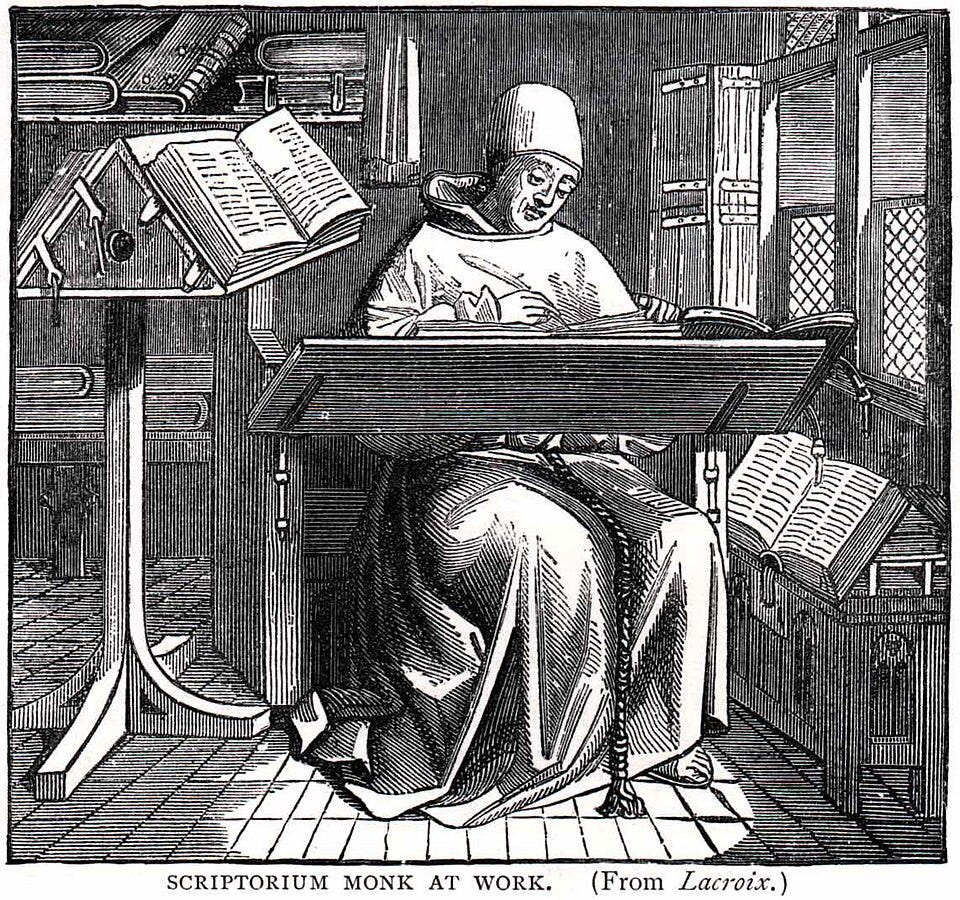
In The Twilight of American Culture (2000), Morris Berman laid out a vision of the “monastic option” and the “new monastic individual,” referring to a type of person and a way of life consciously oriented toward preserving and transmitting forms of consciousness and ways of being that can serve as seeds for some future Renaissance after the dysfunctional current order of things has collapsed. Long-time readers will remember that I have mentioned and discussed this before.
I found Berman’s new monastic model and recommendation magnetically persuasive and congenial to my own sense of things when I first read it in 2004—including his insistence on the necessarily private and small-scale nature of the enterprise. He advised strongly that the new monastic way of life must involve keeping these types of activities essentially solitary and sheltered from the destructive attention of the surrounding culture. The more individual the activity, he argued, and the more out of the public eye, the more effective it was likely to be. “A Taoist rule of thumb,” he wrote, “might be that if the larger culture knows about it, then it’s not the real thing.”1 You don’t make a mass movement out of these things, because then they would necessarily be co-opted and corrupted, and end up serving the very system they’re intended to resist.
Some people are joiners and others aren’t. If it’s possible to lean too far in the latter direction, then I am guilty of that sin or shortcoming. To revise Groucho Marx’s famous quip, I would never be a member of any club that has members. The longer I live, the more my personal antipathy toward and mistrust of institutions and organizations reveals itself as intrinsic, as fundamental.
The idea of the solitary monk, related to others not by any overarching organizational order like a monastery, but simply by natural affinity without external strings, seems ever more like a core ideal. All human institutions and organizations inevitably cross some invisible threshold at some point in their life cycle, after which they no longer serve the end they were originally created to serve, but only their own preservation and perpetuation. They become inward-turned. And they cause all kinds of trouble. (This was, I note, a principle that emerged in my doctoral dissertation on Oswald Chambers’s leadership principles.)
I think this is related to something fundamental in human consciousness that is less pernicious, at least on a mass scale, when it’s allowed to operate primarily at the individual level. We are each a kind of self-contained system that projects its own need for self-perpetuation through the feedback loop of self-consciousness. We conceive ourselves to be separate individuals who must ensure our own survival, and then project this same impulse outward into the institutions and organizations we create. The result is that institutions often become expressions of collective egoism, concerned less with the ends they were created to serve than with their own continued existence. In essence, we create phantom institutions from the aggregating of our phantom selves, and then insist that this aggregation is somehow more real instead of representing the most phantasmal entity of all.
You don’t get that effect, even in a world teeming and swarming with collective phantoms, when you keep your focus and your aim much closer to home. As Berman himself put it, “You can choose a way of life that becomes its own ‘monastery,’ preserves the treasures of our heritage for yourself, and, hopefully, for future generations.”2
I comment on these words in the concluding chapter of Writing at the Wellspring, where I take Berman’s vision as a central pillar:
In the model I am proposing, these “treasures” refer not only to the objects, knowledge, and ways of being that a specific culture and civilization has produced, but to our Original Being, the spiritual source of what we are and what the world is. This monastery of one’s life is where a living connection with reality—I want to give it a capitalization for divine emphasis: Reality—is maintained, and again, not for purely private enjoyment or benefit, but for the leavening and healing influence that this inevitably and inexorably, and also quietly and subtly, broadcasts to others.3
Elsewhere in the book, I say this:
If you are a natural introvert whose creative impulse thrives in and on solitude, and who has felt the same impulse smothered many times by the call and clamor of the outside world, then learn this lesson: You don’t need external solitude to hear the voice of your muse. You can find it right in the middle of a crowd. You can learn to carry your creative silence and solitude with you: a portable inner monastery of the muse.4
Hence, the solitary monk ideal. “You and I can lead the ‘monastic life,’” Berman wrote, “and we can start to do it right now.”5 We can each enact our own calling and let it interact organically with those of others, serving any larger purpose naturally.
Warm regards,

The Living Dark is free to all readers. If you find value here, a paid subscription or one-time donation helps sustain the work. Paid subscribers receive access to the full archive plus the quarterly Living Dark Reader, a PDF journal for slow reading and reflection.
The inner work of the creative life:


PRAISE:
“[An] intimate journey into the mystery of creativity and spirit… Cardin weaves practical methods, personal stories, literary references, and mystical insights into a lyrical meditation on what it means to create from the depths of the soul… both deeply personal and universally resonant.” — BookLife review (Publishers Weekly)
“A guide for writers who welcome the dark and hunger for meaning. — Joanna Penn, author of Writing the Shadow
“I can’t think of any [other books] that link the creative act so uniquely or persuasively with spirituality.” — Victoria Nelson, author of On Writer’s Block and The Secret Life of Puppets
“A meditation on the silence and darkness out of which all creative acts emerge....A guide for writers unlike any other.” — J. F. Martel, author of Reclaiming Art in the Age of Artifice and co-host of Weird Studies
“Important to any writer ready to see through the self illusion and realize the freedom this brings to any creative work.” — Katrijn van Oudheusden, author of Seeing No Self
READER REACTIONS:
“It easily earns its place on my shelf of texts that have challenged and changed how I think about writing and the creative life.”
“One of those magical texts that voices the Truth I secretly always knew.”
“What I’m thoroughly enjoying is the way Matt Cardin weaves those deep, existential questions in and out of the practical, grounded realities of writing itself … This is a book that doesn’t just talk about creativity; it inhabits it.”
“Matt has put into words things that have been alive in me for a long time, but which I have never articulated myself.”
“There is potential here to change your life … Cardin’s writing stirred something dormant in me.”
“This is definitely more than a self-help book on creativity. Matt Cardin’s range of scholarship, casual reading, philosophical spelunking and theological scholarship here forms into one single vision … If Colin Wilson and Krishnamurti and ST Joshi had written a tome on the essentials of creativity, it would be something like this.”
“It was incredible finding an author able to describe how to unlock the skills I’ve been working on even further.”
“This book is by far the best book I have read on creativity. I hope it will reach many people and help them freed from creative block, procrastination, paralyzing self-doubt, and perfectionism.”
“This isn’t a how-to book about writing. It’s a book about why writing matters, and what it’s actually touching when it’s real.”
Morris Berman, The Twilight of American Culture (W. W. Norton, 2000), 131.
Ibid., 157.
Matt Cardin, Writing at the Wellspring: Tapping the Source of Your Inner Genius (Deep Current Press, 2025), 216.
Ibid., 31.
Ibid., 158 (Berman’s emphasis).
I was so grateful to you for introducing Berman’s concept to me (and others) years ago. It’s exerted a significant force in my thinking since then.